


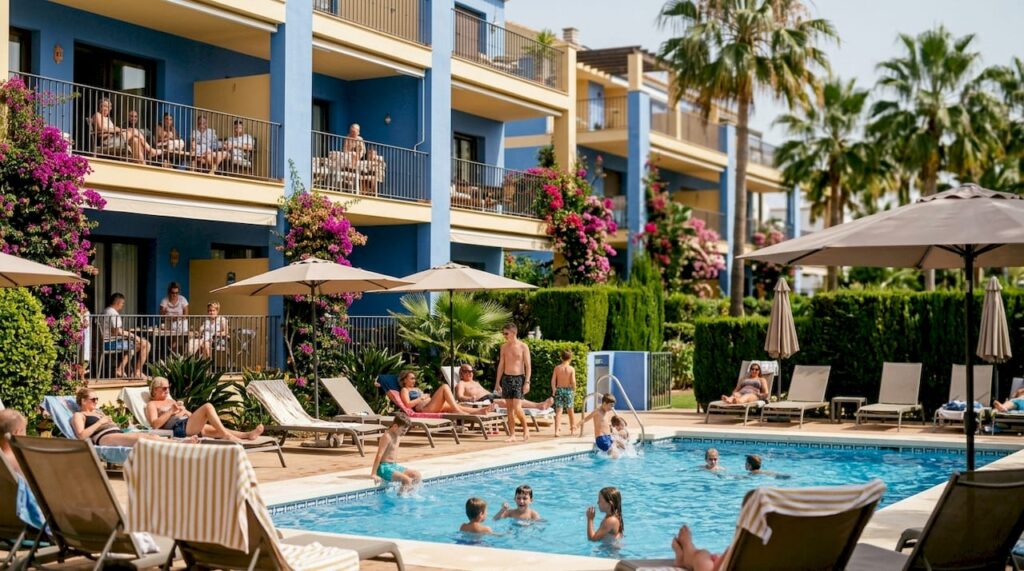
An Estepona urbanisation community is a planned residential development that combines private housing with shared amenities, communal governance, and a structured lifestyle environment. Unlike a standalone villa or a traditional Spanish street, these communities are designed from the ground up to function as self-contained neighbourhoods. The concept has evolved significantly: what was once a collection of holiday apartments around a pool is now, in many cases, a year-round residential destination with international schools, wellness facilities, and permanent infrastructure. If you are researching the Estepona property market, understanding what an urbanisation community actually is will shape every decision you make.
What is an estepona urbanisation community?
An urbanisation community, known in Spanish as an urbanización, is a residential complex or planned neighbourhood where property owners share both physical spaces and legal responsibilities. The term “urbanisation” refers to the formal process of developing land with roads, utilities, and housing to a defined plan. In Estepona, this translates into gated or semi-gated developments ranging from a dozen apartments to hundreds of homes, all governed by a shared management structure.
The key distinction from ordinary housing is the communal element. Every owner in an urbanisation community holds a stake in the shared areas, whether that is a swimming pool, a garden, a car park, or a security gatehouse. That stake comes with both rights and obligations, including monthly or annual community fees. The Estepona lifestyle and property scene is built substantially around these communities, which now account for the majority of new residential supply in the area.
What makes Estepona’s version of this model particularly compelling is the town’s deliberate urban planning policy. The local authority has invested in roads, parks, and public services alongside private development, creating a coherent environment rather than isolated pockets of housing. That coordination is visible in zones like Las Mesas, Cancelada, and the New Golden Mile corridor.
What amenities and features do these communities typically offer?
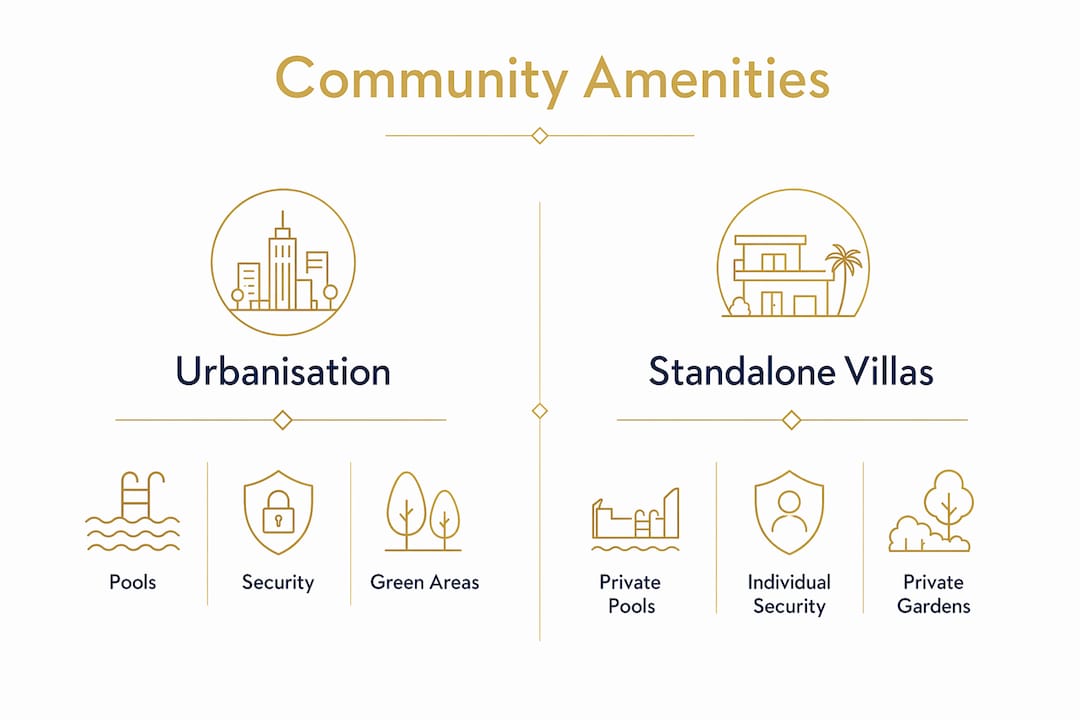
Modern urbanisation communities in Estepona have moved well beyond the basics. The standard package now includes:
- Swimming pools: Heated indoor and outdoor pools are common in premium developments, with dedicated children’s areas and lap lanes.
- Fitness and wellness: Gyms, spa facilities, and yoga terraces appear regularly in projects targeting international buyers.
- Security: Gated access with 24-hour security or video surveillance is standard across mid-range and luxury communities.
- Green spaces: Landscaped gardens, walking paths, and communal terraces are built into the masterplan rather than added as an afterthought.
- Coworking and social spaces: A growing number of developments include residents’ lounges, coworking rooms, and event spaces, reflecting the rise of remote working among expat buyers.
- Parking: Underground or covered parking is typically included per unit, with visitor spaces managed by the community.
MARALTO, a 163-home residential development in Estepona, illustrates this shift clearly. It combines indoor and outdoor pools, a gym, a spa, and social areas within a contemporary architectural framework that prioritises views and landscape integration. That is the benchmark buyers now expect.
The trend across Estepona’s new development zone is towards energy-efficient design, with solar panels, heat pumps, and high-insulation construction becoming standard rather than optional. This matters for running costs and for resale value as European energy regulations tighten.

Pro Tip: When evaluating a community’s amenities, ask for the annual maintenance budget alongside the list of facilities. A development with a spa and two pools but an underfunded maintenance reserve will see those facilities deteriorate within five years. Request the last two years of community accounts before committing.
How do urbanisation communities differ from other residential options?
The clearest way to understand an urbanisation community is to compare it directly with the alternatives available in Estepona.
| Feature | Urbanisation Community | Standalone Villa | Traditional Neighbourhood |
|---|---|---|---|
| Shared amenities | Yes, pool, gym, gardens | No, private only | Rarely, public parks only |
| Security | Gated, managed | Owner’s responsibility | Public streets, no gate |
| Community fees | Mandatory monthly charge | None or minimal | None |
| Governance | Owners’ committee or EUC | None | Local council only |
| Maintenance | Shared cost, managed | Owner’s full responsibility | Council responsibility |
| Social environment | Built-in community | Isolated | Organic, unstructured |
The governance structure is where urbanisation communities get genuinely complex. Two distinct legal entities can manage a community in Spain. The Comunidad de Propietarios (Community of Owners) operates under Horizontal Property Law and manages privately owned shared areas such as pools and lifts. The Entidad Urbanística de Conservación (EUC), by contrast, is a public-law entity responsible for maintaining public infrastructure within a development, including streets, lighting, and green areas, until the local town council formally adopts them. Membership in an EUC is compulsory for all property owners within its boundary. That means you pay fees whether you use the facilities or not, and the fee level is set by the EUC’s governing board rather than by a vote of residents.
Understanding which entity governs a specific community is not a minor detail. It affects your legal obligations, your fee exposure, and your ability to influence how the community is run.
Pro Tip: Always ask your solicitor to confirm whether the development falls under a Comunidad de Propietarios, an EUC, or both. Some urbanisations operate under dual governance, meaning you pay two sets of fees. This is legal but must be disclosed before purchase.
Which areas and new developments feature these communities?
Estepona’s urbanisation communities are concentrated in several distinct zones, each with its own character and price point.
The New Golden Mile is the most prominent corridor. Stretching between Estepona town and San Pedro de Alcántara, it houses a range of gated communities from established complexes to brand-new masterplans. The area is undergoing infrastructure-led transformation with new parks, sports facilities, and public spaces being integrated alongside residential projects. Royal Park Residence and Resort is the flagship example here, combining residences, wellness spaces, and community infrastructure in a single integrated ecosystem designed for permanent living rather than seasonal use.
Cancelada and Las Mesas represent Estepona’s planned expansion zones. New roads, schools, and services are being delivered alongside housing in a coordinated approach that responds to resident demand for quality of life. These areas attract families who want space, good schools nearby, and community infrastructure without the premium price tag of beachfront locations.
West Estepona is emerging as a zone for larger-scale developments targeting buyers who want proximity to the town centre and the beach simultaneously. Several projects in this zone are scheduled for completion in 2026, making it one of the most active areas in the current Estepona new development zone.
Key lifestyle advantages across all these zones include:
- Beach access within 5–15 minutes of most communities
- International schools including Laude San Pedro International College and Atalaya International School within the wider area
- Estepona town centre, with its famous flower-lined streets and weekly market, within easy reach
- Málaga Airport approximately 75 kilometres away, making it practical for frequent travellers
For buyers researching new developments in Estepona, the 2026 pipeline is substantial, with multiple projects across these zones offering off-plan and near-completion opportunities.
What is the social and cultural life like in these communities?
Living in an Estepona urbanisation community is a social experience as much as a property decision. The community-focused environment creates conditions for genuine neighbourly interaction that standalone properties rarely replicate.
The expatriate presence is significant and well-established. British, Scandinavian, Dutch, and German residents make up a large proportion of buyers in Estepona’s urbanisation communities, and this creates a ready-made social network for new arrivals. Residents’ associations organise events ranging from pool parties and barbecues to language exchanges and charity fundraisers. The Estepona expat community is active and welcoming, which matters enormously if you are relocating without an existing social circle.
Andalusian culture permeates community life in ways that distinguish Estepona from more homogenised resort towns. The town’s annual feria, its tapas culture, and its traditional market days are all accessible from within the urbanisation communities, not separated from them. Residents who engage with local life rather than retreating entirely into the expat bubble consistently report higher satisfaction with their decision to move.
Wellness is increasingly central to community design. Developments like MARALTO and Royal Park Residence are built around the idea that residents should be able to exercise, socialise, and relax without leaving the complex. That is a deliberate response to buyer demand, particularly from families and retirees who prioritise health and convenience equally.
Safety is a consistent selling point. Gated access, CCTV, and on-site security personnel create an environment where children play outside and residents leave cars unlocked without anxiety. This is not universal across all communities, but it is the standard in mid-range and premium developments.
What should buyers and investors consider before purchasing?
Buying into an Estepona urbanisation community requires due diligence that goes beyond the property itself. The community’s financial health and governance quality will directly affect your quality of life and your resale value.
- Review the community accounts. Request the last two years of audited accounts for the Comunidad de Propietarios. Look for a healthy maintenance reserve fund. A reserve below 25% of annual expenditure is a warning sign.
- Clarify EUC obligations. If the development falls under an EUC governance structure, confirm the current annual fee, the scope of its responsibilities, and the timeline for local council adoption of public infrastructure. Fees can change significantly once the council takes over.
- Assess management quality. Ask current residents, not just the estate agent, about the responsiveness of the community administrator. Poor management is the single biggest source of dissatisfaction in urbanisation living.
- Check accessibility. Confirm public transport links, proximity to supermarkets, and road access. Some communities in Estepona’s newer zones are car-dependent, which affects both daily life and rental appeal.
- Evaluate investment potential. Estepona’s property market has shown consistent demand growth, supported by coordinated urban planning and international buyer interest. Communities with strong management, modern amenities, and good locations in zones like the New Golden Mile hold value well and generate solid rental yields.
Pro Tip: Visit the community on a weekday morning and a weekend evening before committing. The atmosphere, noise levels, and condition of shared areas tell you more than any sales brochure. Talk to at least three current residents if you can.
Key takeaways
Estepona urbanisation communities offer a structured, amenity-rich lifestyle that standalone properties cannot replicate, but their value depends entirely on governance quality and financial management.
| Point | Details |
|---|---|
| Definition is specific | An urbanisation community combines private housing with shared amenities and formal communal governance. |
| Governance matters legally | Distinguish between Comunidad de Propietarios and EUC before purchase, as both carry mandatory fee obligations. |
| Modern amenities are the standard | Developments like MARALTO and Royal Park Residence set the benchmark with pools, wellness facilities, and social spaces. |
| Location zones vary significantly | The New Golden Mile, Cancelada, and Las Mesas each offer different price points and lifestyle profiles. |
| Due diligence protects your investment | Review community accounts, management quality, and EUC status before signing any contract. |
Why i think buyers still underestimate the governance question
Most buyers arrive in Estepona focused on the view, the pool, and the square footage. Very few arrive asking about the community administrator or the EUC fee schedule. After years of watching buyers navigate the Estepona property market, I am convinced this is the single biggest blind spot in the purchasing process.
The amenities in a well-designed urbanisation community are genuinely life-enhancing. The social fabric, the safety, and the convenience are real. But a community with a beautiful pool and a dysfunctional owners’ committee is a source of stress, not pleasure. I have seen buyers pay a premium for a development with resort-style facilities, only to find that the maintenance reserve was depleted and the pool was closed for repairs within two years of purchase.
The shift towards integrated, year-round communities in Estepona is real and it is accelerating. Buyers seeking expat-friendly communities in Estepona in 2026 have more choice than ever, and the quality of new developments is genuinely impressive. My advice is to match that quality of research to the governance and financial health of the community, not just its facilities. The best urbanisation community is one where the management is as good as the architecture.
— Nina
Find your ideal estepona community property with Omnirealestate
Omnirealestate has spent over a decade matching buyers with the right urbanisation communities across the Western Costa del Sol. Their database of more than 7,500 listings covers everything from compact apartments in established Estepona communities to new-build villas in the latest development zones.
Whether you are drawn to the New Golden Mile’s beachside communities, the family-focused zones of Cancelada, or a brand-new project in West Estepona, Omnirealestate’s husband-and-wife team provides tailored guidance based on real local knowledge. Browse current Estepona homes for sale to see what is available across all community types and price points. For broader context on buying in the region, the Costa del Sol property guide covers everything you need before making an offer.
FAQ
What does “urbanisation community” mean in estepona?
An urbanisation community in Estepona is a planned residential development where owners share amenities such as pools, gardens, and security, governed by a formal management structure. It differs from a standalone property because ownership includes both a private unit and a legal stake in communal areas.
What is the difference between a comunidad de propietarios and an EUC?
A Comunidad de Propietarios manages privately owned shared spaces under Horizontal Property Law, while an EUC (Entidad Urbanística de Conservación) is a public-law body managing public infrastructure within a development until the local council adopts it. EUC membership is compulsory and fees are mandatory for all owners within its boundary.
Which new developments in estepona are examples of urbanisation communities in 2026?
MARALTO, a 163-home development with resort-style amenities, and Royal Park Residence on the New Golden Mile are two prominent current examples. Both represent the shift towards integrated, year-round residential communities rather than seasonal holiday complexes.
Are urbanisation communities in estepona suitable for permanent living?
Yes. Estepona’s urbanisation communities have evolved from holiday-focused complexes into year-round residential destinations with international schools, permanent services, and community infrastructure designed for families and full-time residents.
What community fees should i expect in an estepona urbanisation?
Community fees vary widely depending on the size of the development and the range of amenities. A basic community with a pool and gardens typically charges between €100 and €300 per month. Premium developments with 24-hour security, a gym, and a spa can charge significantly more. Always request a full breakdown of current fees and the maintenance reserve before purchasing.