



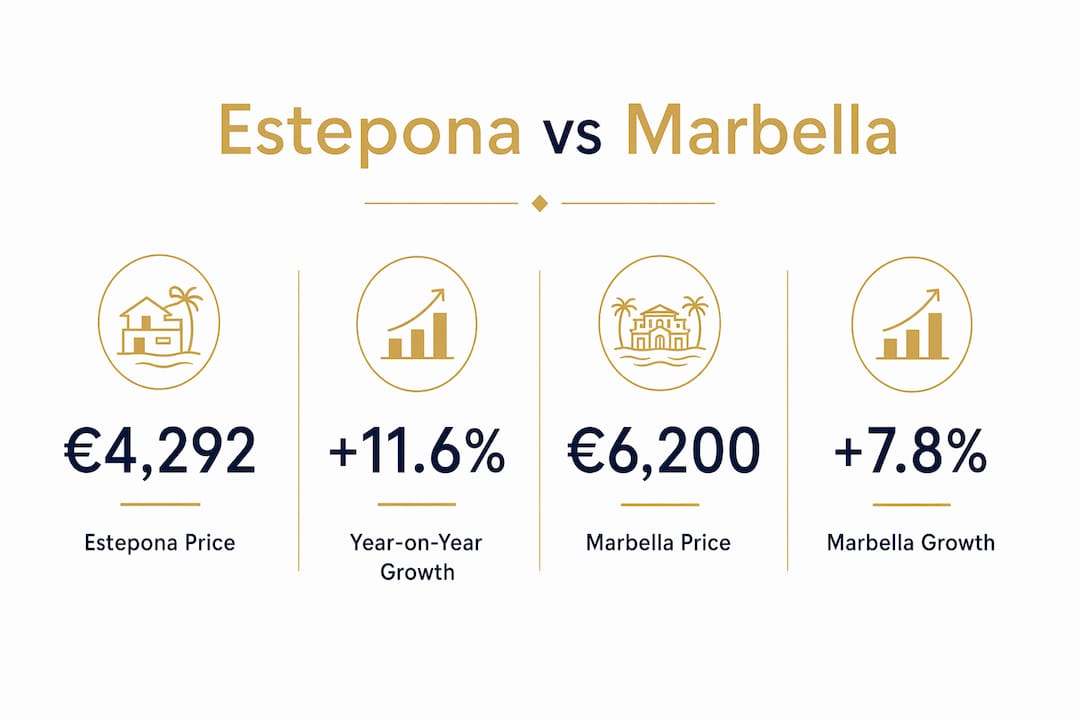
Estepona’s property market is defined by one clear metric in 2026: average prices have risen 11.6% year-on-year, with the cost per square metre now sitting at €4,292. These are not modest adjustments. They signal a market in sustained upward motion, driven by capital appreciation rather than rental income growth. For buyers and investors weighing up the Costa del Sol, understanding what is behind these figures, and what they mean for your decision, is the difference between timing the market well and overpaying for the wrong property.
What is driving estepona property price increases?
Estepona’s price growth is not accidental. Several converging forces have pushed values upward consistently, and each one reinforces the others.
Demand is outpacing supply. Retirees, expatriates, and coastal lifestyle seekers have made Estepona one of the most sought-after addresses on the Western Costa del Sol. The town’s reputation for cleanliness, safety, and a genuinely Spanish character attracts buyers who might previously have defaulted to Marbella. That demographic shift has been building for years and shows no sign of reversing.

Supply constraints compound the pressure. Land availability close to the coastline is limited, and planning permissions for new developments move slowly. The result is that demand consistently exceeds the number of quality properties coming to market, which keeps prices firm even when broader European sentiment softens.
Economic conditions have also played a role. Inflation across the eurozone has pushed investors toward tangible assets, and property on the Costa del Sol is seen as a reliable store of value. Tourism figures for the region remain strong, which supports both short-term rental demand and the general perception that Estepona is a place people want to be.
Key demand drivers at a glance:
- Coastline appeal and Mediterranean climate attracting international buyers
- Growing expat and retiree communities settling permanently rather than seasonally
- Limited coastal land supply preventing new stock from meeting demand
- Inflation-driven appetite for hard assets among European investors
- Strong tourism underpinning short-term rental confidence
Pro Tip: If you are considering a purchase in Estepona, the Estepona lifestyle guide from Omnirealestate covers the specific districts and their individual price characteristics, which matters more than the town-wide average when you are making a buying decision.
How does estepona compare with marbella and nearby towns?
Estepona sits in a compelling position relative to its neighbours. Estepona prices remain lower than Marbella while having delivered stronger growth rates in recent years, with values rising approximately 50% over the past several years. That combination of relative affordability and momentum is precisely what attracts investors who feel Marbella’s prime market has already priced in most of its upside.
| Location | Approx. Price per m² | Recent Annual Growth | Market Character |
|---|---|---|---|
| Marbella (Golden Mile) | €6,500+ | Moderate | Established luxury |
| Marbella (East) | €4,800–€5,500 | Moderate | Mixed residential |
| Estepona | €4,292 | 11.6% | Growth phase |
| Manilva / Sabinillas | €2,800–€3,400 | Steady | Emerging value |
The gap between Estepona and Marbella’s prime zones is narrowing. Buyers who purchased in Estepona five years ago have seen returns that outpace many Marbella micro-markets on a percentage basis. The luxury segment within Estepona is also maturing, with new developments targeting the upper end of the market and pulling the town average upward.
Inland and western coastal towns such as Manilva and Casares still offer significantly lower entry points. These markets suit buyers with a longer investment horizon or those prioritising lifestyle value over near-term capital growth. For a broader view of Costa del Sol investment options, the spread across these towns is worth mapping carefully before committing.
Pro Tip: Beachfront properties in Estepona command a significant premium over inland equivalents. The beachfront property guide from Omnirealestate breaks down exactly where that premium is justified by rental demand versus where it is purely cosmetic.
Rental yields versus capital growth: what do the numbers say?
This is the question every investor needs to answer before buying. The Estepona housing price analysis for 2026 tells a clear story: capital appreciation is the primary return driver, not rental income.
Median gross rental yield stands at approximately 5.8%, which is respectable by European standards. However, rental income has remained broadly flat despite rising property values, with average asking rents holding at €2,500–€3,000 per month. That means the yield percentage is actually compressing as prices rise. An investor buying today at €4,292 per square metre is accepting a lower yield than someone who bought two years ago at a lower price point.
The district-level data is where this gets interesting. Rental yields across Estepona’s districts range from 1.87% to nearly 11%, depending on property type, location, and management quality. That spread is enormous and underlines why town-wide averages can mislead. A poorly located apartment in an oversupplied district might yield under 2%, while a well-managed property near the marina or old town can approach double digits.
| Investment Focus | Typical Yield Range | Key Consideration |
|---|---|---|
| Beachfront apartments | 4%–7% | High demand, strong seasonal occupancy |
| Town centre flats | 5%–9% | Year-round rental appeal |
| Luxury villas | 2%–5% | Capital growth primary driver |
| Inland properties | 1.87%–4% | Lower entry cost, weaker rental demand |
For investors focused on capital growth, investment focus is shifting toward appreciation as the dominant return mechanism. Patience and disciplined pricing matter more than chasing the highest headline yield. A realistic investment horizon of five to seven years allows the appreciation cycle to work in your favour while rental income covers holding costs.
- Properties near the marina and old town show the strongest rental consistency
- New developments often carry a premium that takes longer to recover through yield alone
- Short-term holiday lets can significantly boost gross yield but require active management
- Ownership costs including community fees, property tax, and maintenance reduce net yield by roughly 1%–2%
What steps should buyers follow in the current estepona market?
Understanding the Estepona buying process steps is as important as understanding the price trends. The purchase process in Spain has specific legal and financial requirements that differ from the UK, and getting them wrong is expensive.
-
Obtain an NIE number. This is your Spanish tax identification number and is required before any property transaction can proceed. Apply through the Spanish consulate in the UK or at a local police station in Spain.
-
Open a Spanish bank account. Funds for the purchase, taxes, and ongoing costs must flow through a Spanish account. Most banks require your NIE before opening one.
-
Appoint an independent solicitor. Your lawyer conducts due diligence on the property, checks for debts or encumbrances, and manages the legal transfer. Never use a solicitor recommended solely by the selling agent.
-
Sign the reservation agreement and pay the deposit. Typically 1%–3% of the purchase price secures the property while due diligence is completed.
-
Sign the private purchase contract. This is usually accompanied by a 10% deposit. Pulling out after this point means losing that deposit.
-
Complete at the notary. The final deed is signed before a Spanish notary, and the balance is transferred. Keys are handed over at this stage.
The Estepona property purchase costs breakdown includes transfer tax at 7% of the purchase price for resale properties, plus notary fees, land registry fees, and legal costs. Typical purchase costs add roughly 10%–13% on top of the agreed price. For new developments, VAT at 10% replaces transfer tax, plus a stamp duty of 1.2%.
Ongoing Estepona property ownership costs include annual property tax (IBI), community fees for apartments and urbanisations, rubbish collection charges, and utility connections. Budget approximately 1%–2% of the property value annually for these recurring costs.
Pro Tip: For buyers financing through a mortgage, Omnirealestate’s guide on financing property in Spain covers the specific requirements for non-resident buyers, including loan-to-value limits that differ from UK norms.
Key takeaways
Estepona’s property market in 2026 is a capital appreciation story, where rising prices and constrained supply make early entry and disciplined buying the most reliable path to returns.
| Point | Details |
|---|---|
| Prices rising sharply | Average price per m² reached €4,292, up 11.6% year-on-year as of June 2026. |
| Capital growth leads returns | Rental yields are compressing as prices rise; appreciation is the primary investor return. |
| District yields vary widely | Yields range from 1.87% to nearly 11%, so location within Estepona matters enormously. |
| Estepona underprices Marbella | Estepona remains more affordable than Marbella while delivering stronger recent growth rates. |
| Purchase costs add 10%–13% | Buyers must budget for transfer tax, legal fees, and notary costs on top of the agreed price. |
What i have learnt watching estepona’s market evolve
I have been working in this market long enough to remember when Estepona was the quieter alternative to Marbella, the place buyers settled for when they could not stretch the budget. That framing is now completely outdated, and the buyers who recognised the shift early have been rewarded handsomely.
What strikes me most about the current moment is how the yield conversation has changed. Five years ago, clients came to me asking about rental returns first and capital growth second. Today, the serious investors ask about appreciation potential and treat rental income as a bonus rather than the primary justification. That shift reflects a maturing market, and it is the right instinct given where yields are heading.
My honest concern is buyers who anchor on the 5.8% median yield without digging into the district-level data. A 1.87% yield on a property that is also appreciating more slowly than the town average is a poor investment by any measure. The spread between the best and worst-performing districts is wider than most buyers realise, and that gap is not closing.
For timing, I would not wait for a correction that may not come. The supply constraints are structural, not cyclical. What I would do is be precise about location within Estepona, prioritise properties with genuine year-round rental appeal over purely seasonal ones, and build in a five-year minimum horizon. The market rewards patience here more than it rewards speculation.
— Nina
How Omnirealestate helps you buy smarter in estepona
Omnirealestate has spent over a decade specialising in the Western Costa del Sol, with a database of more than 7,500 listings across Estepona, Casares, Manilva, and the surrounding area. That depth of local knowledge means you get specific guidance on which districts are outperforming, which new developments represent genuine value, and what a realistic purchase checklist looks like for your budget and goals.

Whether you are searching for a beachfront apartment, a golf villa, or a traditional Spanish home, the Omnirealestate property search gives you direct access to current listings with tailored recommendations. If you want an accurate picture of what your budget buys right now, a property valuation from the team gives you a grounded starting point before you commit to anything.
FAQ
What is the average property price per m² in estepona in 2026?
The average price per square metre in Estepona reached €4,292 as of June 2026, representing an 11.6% year-on-year increase. Monthly momentum also remains strong, with a 3.2% rise recorded month-on-month.
Are rental yields in estepona worth investing for?
Median gross rental yields sit at approximately 5.8%, but yields vary from 1.87% to nearly 11% depending on district and property type. Capital appreciation is currently the stronger return driver as rental income has remained flat despite rising prices.
How does estepona compare to marbella for property investment?
Estepona offers lower average prices than Marbella while delivering stronger recent growth rates, with values rising approximately 50% over recent years. Investors seeking growth potential at a lower entry point increasingly favour Estepona over Marbella’s more established prime zones.
What are the main costs when buying property in estepona?
Buyers should budget an additional 10%–13% on top of the agreed purchase price to cover transfer tax at 7%, notary fees, land registry fees, and legal costs. New development purchases replace transfer tax with 10% VAT plus 1.2% stamp duty.
Is now a good time to buy property in estepona?
Supply constraints in Estepona are structural rather than temporary, which means the upward price pressure is unlikely to reverse sharply in the short term. Buyers with a five to seven year horizon and a clear focus on location within the town are well-positioned to benefit from continued appreciation.