



The annual costs of owning a home in Spain include mandatory municipal property taxes, community fees, home insurance, utilities, and a non-resident income tax for owners who live outside Spain. These are the formal property holding costs, known collectively as gastos de mantenimiento, and they typically represent 1% to 2% of the property’s value each year. For a 2-bedroom coastal apartment, total annual running costs fall between €2,000 and €3,610. For a 3-bedroom villa with a pool, expect €2,610 to €5,250. Knowing each component before you buy is the difference between a sound investment and an unwelcome surprise.
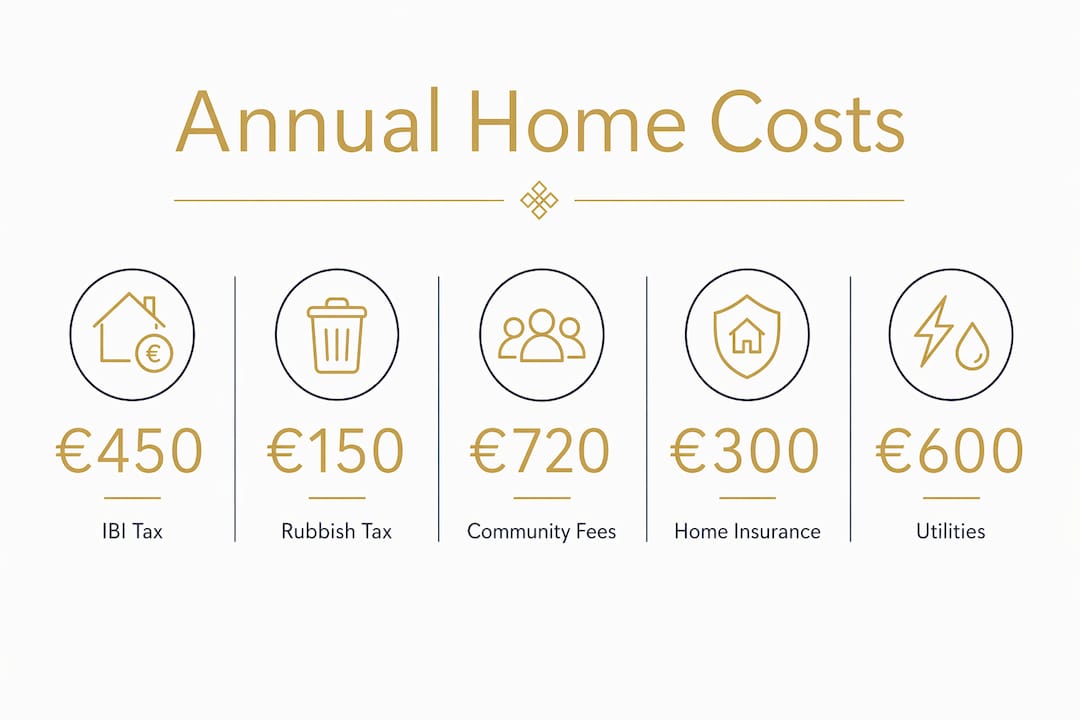
What are the annual costs of owning a home in Spain?
Spain’s property holding costs divide into five clear categories: the Impuesto sobre Bienes Inmuebles (IBI), the rubbish collection tax, the non-resident income tax (IRNR), community fees, insurance, and utilities. Each carries its own calculation method, payment schedule, and legal obligation. Missing any one of them can result in fines or debt registered against the property itself.
IBI: Spain’s annual municipal property tax
The IBI is the cornerstone of annual property taxes Spain imposes on every owner. It is calculated as 0.4% to 1.1% of the cadastral value, which is the official government valuation of the property. Crucially, cadastral value is almost always significantly lower than market price. That gap works in your favour. Typical IBI bills run €250–€450 for apartments and €450–€1,200 for villas, depending on location and property size.
The IBI is billed directly by the local municipality, usually between july and november. Most town halls offer a direct debit discount of 2%–5% if you set up automatic payment. Estepona, Manilva, and Casares each set their own rates within the national band, so the same property type can carry a meaningfully different bill depending on which municipality it sits in.
Rubbish collection tax and IRNR for non-residents
The rubbish collection tax (Tasa de Basuras) is a separate municipal charge, typically €100–€200 per year. It is often billed alongside the IBI or issued as a standalone annual notice. Non-resident owners face an additional obligation: the IRNR, or Impuesto sobre la Renta de No Residentes.
The IRNR taxes deemed rental income even when the property is not rented out. The calculation uses 1.1% or 2% of the cadastral value as a notional income figure, then applies a tax rate of 19% for EU and EEA citizens or 24% for all others. For a property with a cadastral value of €80,000, an EU citizen would pay roughly €167 per year in IRNR. The filing deadline is 31 december of the year following the tax year, using Modelo 210.
Pro Tip: Non-resident owners often overlook IRNR entirely. Failing to file triggers penalties even when the tax amount itself is modest. A gestor for tax filings costs €100–€300 per year and removes this risk completely.
How do community fees and insurance affect ownership expenses?
Community fees and home insurance together form a significant and often underestimated portion of home ownership expenses in Spain. Both are recurring annual commitments that vary sharply by property type and location.
Community fees: what you pay and why
Community fees, formally called cuotas de comunidad de propietarios, cover the shared costs of maintaining communal areas. This includes swimming pools, gardens, lifts, security systems, and building insurance for the structure itself. Community fees are a legal obligation for every owner within a community, regardless of how often you use the property or visit Spain.
The cost range is wide. Basic apartment complexes charge €30–€60 per month. Luxury developments with concierge services, multiple pools, and 24-hour security charge €150–€300 per month. Villas within urbanisations typically pay €30–€100 per month for shared road and garden maintenance. A detached villa outside any community pays no community fee but carries the full cost of private pool, garden, and exterior maintenance.

| Property type | Typical monthly fee | Annual total |
|---|---|---|
| Basic apartment complex | €30–€60 | €360–€720 |
| Mid-range urbanisation | €60–€150 | €720–€1,800 |
| Luxury complex | €150–€300 | €1,800–€3,600 |
| Villa in urbanisation | €30–€100 | €360–€1,200 |
Pro Tip: Always request the community’s last three years of meeting minutes and accounts before purchasing. Unpaid community debts transfer to the new owner under Spanish law, and large pending repair funds can appear with no warning.
Home insurance: coverage and typical premiums
Home insurance in Spain is not legally mandatory unless the property is mortgaged, but annual insurance is strongly advised for all owners. A standard policy covers the building structure, contents, and third-party liability. Premiums range from €150–€500 per year depending on property size, location, and the level of contents cover selected. Villas with pools and larger floor areas sit at the higher end. Apartments in managed communities often require only contents cover, since the community’s building insurance covers the structure.
What utility and maintenance costs should you budget for annually?
Utilities and routine maintenance are the most variable component of the cost of living in Spain as a homeowner. They depend heavily on how often you occupy the property and what facilities it includes.
Electricity, water, and internet
Electricity is the largest utility bill for most Spanish homeowners. Air conditioning in summer and heating in winter drive consumption significantly. A typical apartment might spend €60–€100 per month on electricity during peak months and considerably less in spring. Villas with pools add pump and heating costs on top.
Fixed standing charges apply to electricity and water accounts even when the property sits empty. This catches many holiday home owners off guard. Reducing your contracted power capacity (potencia contratada) while the property is unoccupied is a straightforward way to cut standing charges by 30%–40%. Water bills are generally modest, averaging €20–€40 per month for regular use. Internet and telecommunications packages from providers such as Movistar, Orange, or Vodafone España typically cost €30–€50 per month.
- Electricity: €40–€120/month depending on season, property size, and pool
- Water: €20–€40/month for typical residential use
- Internet and phone: €30–€50/month with a standard fibre package
- Gas (where applicable): €30–€80/month in winter for heated properties
Garden, pool, and general maintenance
Maintenance costs for homes in Spain vary most between apartments and villas. Apartment owners within a community pay for shared maintenance through their community fee. Villa owners carry the full cost privately. A weekly garden and pool maintenance service in the Costa del Sol area typically costs €150–€300 per month. Annual pool servicing, including chemical treatment and equipment checks, adds a further €300–€600.
Hiring domestic staff privately in Spain triggers Spanish social security registration requirements. Using registered cleaning or maintenance companies avoids this compliance risk entirely. Budget a further €500–€1,500 per year for general repairs, painting, and appliance servicing, regardless of property type.
How does residency status affect your annual ownership costs?
Residency status is the single biggest variable in calculating your total annual bill. The difference between resident and non-resident ownership is not just administrative. It changes which taxes you file and how much you pay.
Spanish tax residents do not pay the IRNR. Instead, they declare any rental income or imputed income through their annual personal income tax return (IRPF). Non-residents must file the IRNR separately, using Modelo 210, and the Spanish Tax Agency treats this as a distinct compliance obligation. Many non-resident owners miss this filing entirely, which leads to penalties that accumulate quietly over several years.
| Cost category | Non-resident apartment | Non-resident villa | Resident apartment |
|---|---|---|---|
| IBI | €250–€450 | €450–€1,200 | €250–€450 |
| IRNR | €100–€300 | €200–€600 | Not applicable |
| Community fees | €360–€720 | €360–€1,200 | €360–€720 |
| Insurance | €150–€300 | €300–€500 | €150–€300 |
| Utilities | €1,200–€1,800 | €1,800–€3,000 | €1,200–€2,400 |
Investors using the property as a rental asset face additional obligations. Rental income must be declared quarterly via Modelo 210 for non-residents, and actual expenses such as community fees, insurance, and repairs can be deducted by EU residents but not by non-EU owners. Understanding this distinction before purchase is critical for accurate investment return calculations. The buying costs in Spain add a further 10%–13% on top of the purchase price, so the annual holding costs are only part of the full financial picture.
Key takeaways
Annual home ownership costs in Spain are predictable and manageable once you understand each component, but non-resident tax obligations and community fee liabilities catch many foreign buyers unprepared.
| Point | Details |
|---|---|
| Total annual cost range | Expect €2,000–€3,610 for apartments and €2,610–€5,250 for villas annually. |
| IBI is calculated on cadastral value | Cadastral value is lower than market price, so IBI bills are more modest than buyers expect. |
| IRNR is mandatory for non-residents | EU citizens pay 19% on notional income; non-EU citizens pay 24%, filed via Modelo 210. |
| Community fees are a legal obligation | Owners cannot opt out; unpaid fees transfer to the new buyer under Spanish law. |
| Reduce standing charges when absent | Lowering contracted electricity capacity during vacancy cuts utility costs significantly. |
What I have learnt from a decade of watching buyers get this wrong
After more than ten years working in the Western Costa del Sol property market, I have seen the same pattern repeat itself. Buyers spend months researching purchase prices and mortgage rates, then discover the annual running costs only after they have signed. The IBI rarely surprises anyone. The IRNR surprises almost everyone.
The most common mistake I see is treating the IRNR as optional. It is not. The Spanish Tax Agency cross-references property ownership records with tax filings, and the penalties for missed years stack up. A gestor costs less than a single year’s penalty, and the peace of mind is worth far more. I always recommend engaging one before the first tax year ends, not after the first fine arrives.
Community fees deserve more scrutiny than most buyers give them. A luxury complex with a €250 monthly fee sounds manageable until you factor in a special levy for roof repairs or lift replacement. These extraordinary charges are legal, common, and not always visible in the sales brochure. Reading the community accounts before you exchange is not optional due diligence. It is the only way to know what you are actually buying into.
On utilities, the single most practical tip I can offer is this: reduce your contracted electricity capacity the moment you leave for an extended period. It takes one phone call to your supplier and saves a meaningful amount every month the property sits empty. For holiday home owners in southern Spain, this one habit can save €200–€400 per year with no downside.
The cost of living in Spain as a homeowner is genuinely affordable compared to the UK or northern Europe. The key is going in with accurate numbers, not optimistic ones.
— Nina
How Omnirealestate helps international buyers plan their purchase
Understanding the annual costs of owning a home in Spain is only half the picture. Finding the right property at the right price, in a location where those costs are proportionate to the lifestyle on offer, is where expert local knowledge makes the real difference.

Omnirealestate has spent over ten years specialising in property along the Western Costa del Sol, covering Estepona, Casares, Sabinillas, Duquesa, and Manilva. The team works directly with international buyers to match budget, lifestyle, and cost expectations before any offer is made. With a database of over 7,500 listings and a genuinely personal service from a husband-and-wife team who live and work in the area, Omnirealestate gives you the local insight that online searches simply cannot replicate. Start your search with the property finder tool or browse the full property search to find homes that fit your annual budget from day one.
FAQ
What are the main annual costs of owning a home in Spain?
The main annual costs are IBI property tax, rubbish collection tax, community fees, home insurance, utilities, and the IRNR non-resident income tax for owners who live outside Spain. Together these typically represent 1%–2% of the property’s market value each year.
How much is the IBI property tax in Spain?
IBI is calculated at 0.4%–1.1% of the cadastral value, producing typical bills of €250–€450 for apartments and €450–€1,200 for villas. Cadastral value is lower than market price, so the actual bill is more modest than the percentage suggests.
Do non-residents have to pay tax on a Spanish property they do not rent out?
Yes. Non-resident owners must file the IRNR annually, which taxes a notional rental income based on 1.1%–2% of the cadastral value. EU and EEA citizens pay 19%; all other nationalities pay 24%.
Are community fees compulsory in Spain?
Community fees are a legal obligation under the Community of Owners statutes and cannot be avoided or waived. Unpaid fees become a registered debt against the property and transfer to the new owner on sale.
How can I reduce utility costs when my Spanish property is unoccupied?
Reducing your contracted electricity capacity while the property is empty cuts standing charges by a significant margin. Contact your electricity supplier directly to lower the potencia contratada, and reinstate it before your next visit.