



Costa del Sol property values rise because of three forces working together: sustained international demand, a chronic shortage of housing supply, and the region’s shift from a seasonal holiday destination to a permanent residential hub. Prime Marbella prices grew 12% in 2025, with forecasts pointing to a further 7–8% increase in 2026. Property values in the Golden Triangle have risen over 50% since their 2008 lows. For buyers and investors assessing the Costa del Sol housing market, understanding these drivers is the difference between a well-timed purchase and a missed opportunity.
Why Costa del Sol property values rise: the role of international demand
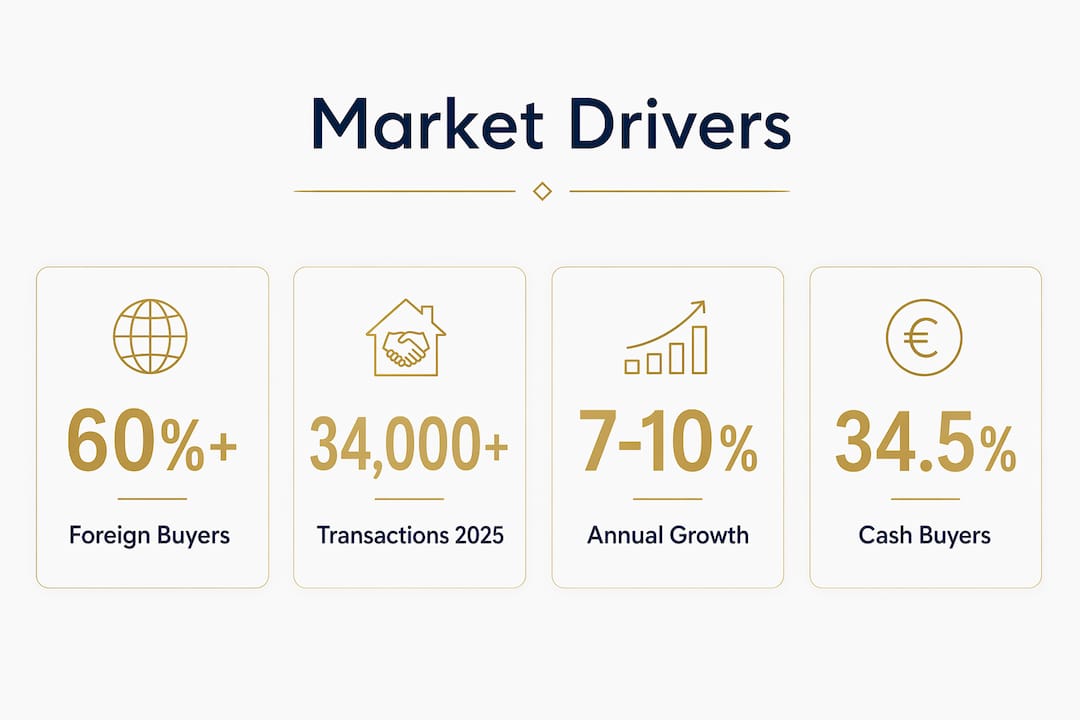
International buyers are the single most powerful force behind Costa del Sol real estate demand. Over 60% of purchases in the Golden Triangle come from foreign buyers, and in the luxury segment that figure climbs to nearly 90%. That concentration of overseas capital in one region creates persistent upward pressure on prices that local market conditions alone cannot explain.
The buyer profile is broad and financially strong. Buyers from the UK, USA, Scandinavia, Germany, and the Middle East all compete for the same limited stock. The average international buyer has 80% higher purchasing power than local residents. That gap means international buyers can absorb price increases that would price out a domestic market, which is precisely what has happened across Estepona, Marbella, and Manilva.

Málaga province recorded over 34,000 property transactions in 2025, with foreign buyers contributing roughly 32–35% of the total. That volume confirms this is not a niche luxury trend. It is a broad, deep market with buyers at multiple price points, from mid-range apartments in Sabinillas to high-end villas in Casares.
The geographic diversity of buyers also acts as a buffer. When one nationality pulls back due to domestic economic pressures, others fill the gap. That substitution effect is one reason why Costa del Sol real estate demand has remained resilient through periods of global uncertainty.
Key buyer nationalities active in the market include:
- British buyers seeking lifestyle, climate, and long-term capital growth
- Scandinavian buyers attracted by year-round sunshine and quality of life
- American buyers benefiting from a favourable dollar-to-euro exchange rate
- Middle Eastern buyers prioritising privacy, security, and luxury amenities
Pro Tip: If you are buying in a market with strong international competition, move quickly on well-priced listings. Properties in prime areas like Estepona and Duquesa rarely sit unsold for long. Omnirealestate’s database of over 7,500 listings gives you a real advantage in spotting new stock early.
How does housing supply shortage push property prices higher?
Supply is the structural constraint that turns demand into price growth. Spain faces a severe housing deficit, and the Costa del Sol sits at the sharp end of that problem. Only 335 social housing permits were issued out of nearly 9,500 total housing permits in Málaga in 2025. That figure reveals how little affordable stock is entering the market relative to overall building activity.
Planning restrictions, rising construction costs, and constrained prime land availability reinforce structural supply scarcity that supports elevated property valuations. Municipal authorities along the coast have tightened development controls to protect the environment and manage tourism pressure. The result is a pipeline of new homes that cannot keep pace with demand.
The resale market compounds the problem. Owners who bought at lower prices are reluctant to sell, knowing that replacement stock at comparable prices does not exist. Local buyers are increasingly priced out, which means the resale pool shrinks further as owners hold onto assets rather than trade up or downsize.
This stands in stark contrast to 2007, when an oversupply of speculative new builds created the conditions for a sharp correction. The current market has no equivalent inventory glut. Supply is tight, demand is high, and that combination produces one outcome: rising prices.
The supply constraints break down into four distinct layers:
- Planning restrictions limit the number of new developments approved each year in coastal municipalities
- Construction cost inflation reduces developer margins and slows new build starts
- Land scarcity in prime coastal zones means new supply cannot simply be added at will
- Owner retention keeps resale stock off the market, reducing choice for active buyers
| Factor | 2007 market | 2026 market |
|---|---|---|
| New build supply | Oversupplied, speculative | Constrained, demand-led |
| Buyer profile | Leveraged, mixed quality | Cash-rich, high net worth |
| Social housing output | Higher proportional share | 335 permits from 9,500 total |
| Market risk | Bubble conditions | Supply-driven price support |
Pro Tip: Off-plan properties in Costa del Sol can offer entry prices below completed market value. Read Omnirealestate’s guide to off-plan property before committing, as planning timelines and developer track records vary considerably.
Has Costa del Sol become a year-round destination, and does that affect values?
The Costa del Sol has completed a fundamental shift from seasonal holiday market to permanent residential hub. That transition matters enormously for property values because it replaces cyclical, tourism-driven demand with stable, year-round occupancy and purchasing activity. The market now serves high-net-worth individuals, remote workers, and entrepreneurs who live here full-time or for the majority of the year.
Infrastructure investment has accelerated this shift. Málaga Airport handled over 22 million passengers in 2025, connecting the region to over 130 destinations. That level of connectivity makes the Costa del Sol genuinely accessible for professionals who need to travel regularly for work. It is no longer a remote retreat. It is a well-connected base.
Málaga city has emerged as a recognised technology hub, attracting professionals from across Europe and beyond. International schools, private healthcare facilities, and upgraded road and rail networks have followed. These investments serve permanent residents, not tourists, which signals a structural change in who the market is built for.
The lifestyle factors that originally attracted holiday buyers now underpin permanent residency decisions:
- Climate: over 300 days of sunshine annually, reducing the appeal of returning to northern Europe
- Healthcare: private and public facilities of a standard that meets international buyer expectations
- Education: a growing number of international schools serving English, German, and Scandinavian curricula
- Community: established expatriate networks in areas like Duquesa, Manilva, and Estepona that ease the transition to permanent living
This demographic shift stabilises the market in a way that seasonal demand never could. Permanent residents do not sell when summer ends. They invest in their properties, improve them, and hold them for the long term. That behaviour reduces supply further and supports values across all price points. For buyers considering relocating to Costa del Sol, this permanence is a significant part of the investment case.
How do financial factors protect the Costa del Sol market from economic shocks?
The financial structure of the Costa del Sol market is one of its least-discussed strengths. Cash transactions accounted for 34.5% of purchases in Q1 2025. That is a high proportion by any European standard. It means a large share of the market is entirely insulated from Euribor rate movements and mortgage credit conditions.
The lack of reckless credit is the clearest sign that this market is not a bubble. In 2007, overleveraged buyers and speculative lending created conditions that collapsed when credit tightened. The current market is driven by buyers who do not need financing. That removes the primary mechanism through which property markets typically crash.
For UK buyers, sterling-to-euro exchange rate volatility is a genuine concern on paper. In practice, capital appreciation of 7–10% annually in prime areas over a 5–7 year holding period neutralises currency risk. A property that grows in value by 50% over seven years absorbs significant exchange rate movement without eroding the investor’s return.
| Financial factor | Impact on market stability |
|---|---|
| Cash buyer share (34.5% Q1 2025) | Reduces sensitivity to interest rate rises |
| Low financial leverage | Prevents forced selling in downturns |
| Annual prime price growth (7–10%) | Offsets sterling-euro exchange rate risk |
| High-net-worth buyer base | Sustains demand regardless of credit conditions |
Pro Tip: UK buyers should model their returns in sterling, not euros. A 7–10% annual gain in a prime Costa del Sol property can absorb meaningful exchange rate movement over a five-year hold. Omnirealestate’s team can connect you with currency specialists who work specifically with British buyers in Spain.
Key takeaways
Costa del Sol property values rise because international demand, supply constraints, and permanent residency trends combine to create a structurally resilient market that outperforms broader European benchmarks.
| Point | Details |
|---|---|
| International demand drives prices | Foreign buyers account for over 60% of Golden Triangle purchases, with 80% higher purchasing power than locals. |
| Supply is structurally constrained | Planning restrictions and owner retention keep available stock low, supporting elevated valuations. |
| Year-round residency stabilises values | The shift from holiday market to permanent hub replaces seasonal demand with consistent buying activity. |
| Cash buyers insulate the market | A 34.5% cash transaction rate in Q1 2025 reduces vulnerability to interest rate and credit shocks. |
| Currency risk is manageable | Prime area capital growth of 7–10% annually neutralises sterling-euro exchange rate volatility over time. |
What the market signals tell me after a decade on the ground
I have watched buyers come and go along the Western Costa del Sol for years, and the pattern that stands out most is this: the buyers who hesitate rarely get the property they wanted at the price they hoped for. The market does not wait.
What the data confirms, and what I see in practice, is that the Costa del Sol is no longer a speculative play. It is a lifestyle investment with genuine capital growth attached. The buyers I speak with are not gambling on a rising market. They are choosing a place to live, work, and build wealth simultaneously. That combination is rare in European real estate.
The area I would caution buyers about is the mid-range resale segment in less established inland locations. Negotiation room exists there, and prices have not moved as sharply as coastal and prime zones. That can be an opportunity, but it requires local knowledge to identify which properties have genuine upside and which are priced optimistically by owners who bought at the wrong moment.
Infrastructure investment is the signal I watch most closely. When Málaga Airport expands capacity, when a new international school opens, when a tech company announces a regional office, property values in the surrounding areas follow. The Costa del Sol is still in an infrastructure growth phase, and that means the underlying drivers of value growth are not exhausted. Buyers who understand the best areas to buy will position themselves ahead of the next wave of demand.
— Nina
How Omnirealestate helps you act on Costa del Sol market conditions
Understanding why property values rise is only useful if you can act on it. Omnirealestate has been working in the Western Costa del Sol for over ten years, specialising in Estepona, Casares, Sabinillas, Duquesa, and Manilva. The team knows which areas are seeing the sharpest demand, which new developments represent genuine value, and where negotiation room still exists.
With a database of over 7,500 listings and a personalised service run by a husband and wife team, Omnirealestate gives buyers direct access to stock that rarely reaches the open market. Whether you are searching for a Costa del Sol investment property or a permanent home, the team responds quickly and matches buyers to properties that fit their criteria precisely. Start your search through the property search tool or contact the team directly for a tailored shortlist.
FAQ
Why do Costa del Sol property prices keep rising?
Prices rise because international demand consistently outpaces available supply. Planning restrictions limit new builds, and cash-rich buyers from the UK, USA, and Scandinavia compete for a shrinking pool of properties.
Is the Costa del Sol property market a bubble?
The market is not a bubble. Unlike 2007, it is driven by genuine high-net-worth demand and cash transactions rather than speculative lending, which removes the primary conditions for a sharp correction.
What percentage of buyers in Costa del Sol are foreign?
Foreign buyers account for roughly 32–35% of total transactions across Málaga province, rising to over 60% in the Golden Triangle and nearly 90% in the luxury segment.
Does the sterling-euro exchange rate affect UK buyers’ returns?
Exchange rate volatility is a factor, but prime Costa del Sol properties have delivered capital growth of 7–10% annually over five to seven year holding periods, which effectively offsets currency risk for long-term investors.
Which areas of Costa del Sol have the strongest property value growth?
The Golden Triangle, which covers Marbella, Benahavís, and Estepona, records the strongest growth, with prime Marbella prices forecast to rise 7–8% in 2026 following 12% growth in 2025.