


Buying off-plan property in Spain means purchasing a home before construction is complete, secured by a staged payment system and mandatory legal protections that, when properly enforced, make it one of the safer ways to invest in Spanish real estate. Under Law 38/1999, developers must provide an individualised bank guarantee covering 100% of your payments plus approximately 4% statutory interest. This protection is the foundation of every off-plan transaction. The key parties involved are the developer, the buyer, an independent lawyer, and a notary. Timelines from reservation to handover typically run 18 to 36 months, so understanding each stage before you commit is not optional. It is the difference between a sound investment and a costly mistake.
What legal guarantees must foreign buyers demand before paying?
The bank guarantee is the single most important document in any off-plan purchase in Spain. Law 38/1999 and its 2015 amendments require developers to provide either an individualised bank guarantee or an insurance policy covering every euro you pay, plus statutory interest of around 4%. This is not a general developer policy. It must name you personally and identify the specific unit you are buying.

Generic developer policies do not protect individual buyers. If the guarantee certificate does not explicitly state your name and your apartment or villa number, it offers you no legal recourse in the event of developer insolvency. Demand a new, updated certificate for every payment milestone, not just at the point of signing the private contract.
Funds should be held in a segregated account, separate from the developer’s operating finances. Your contract must explicitly reference the guarantee and link each payment to a corresponding certificate. Before transferring any money, your lawyer should confirm in writing that a valid, current guarantee is in place.
Key documents to request and verify before any payment:
- The individualised bank guarantee certificate naming you and your unit
- Confirmation that funds go into a segregated account
- The developer’s building licence (Licencia de Obras)
- The developer’s company registration and financial standing
- Written confirmation from your lawyer that the guarantee is valid and current
Pro Tip: Never transfer funds based on a verbal assurance or a generic policy document. If the developer cannot produce an individualised guarantee certificate before your payment is due, treat that as a serious warning sign and pause the transaction until it is resolved.
How does the off-plan payment structure work?
Off-plan payment milestones follow a structured schedule tied to construction progress, not to calendar dates. Understanding this structure protects you from cash flow surprises and ensures your bank guarantee remains valid at each stage.
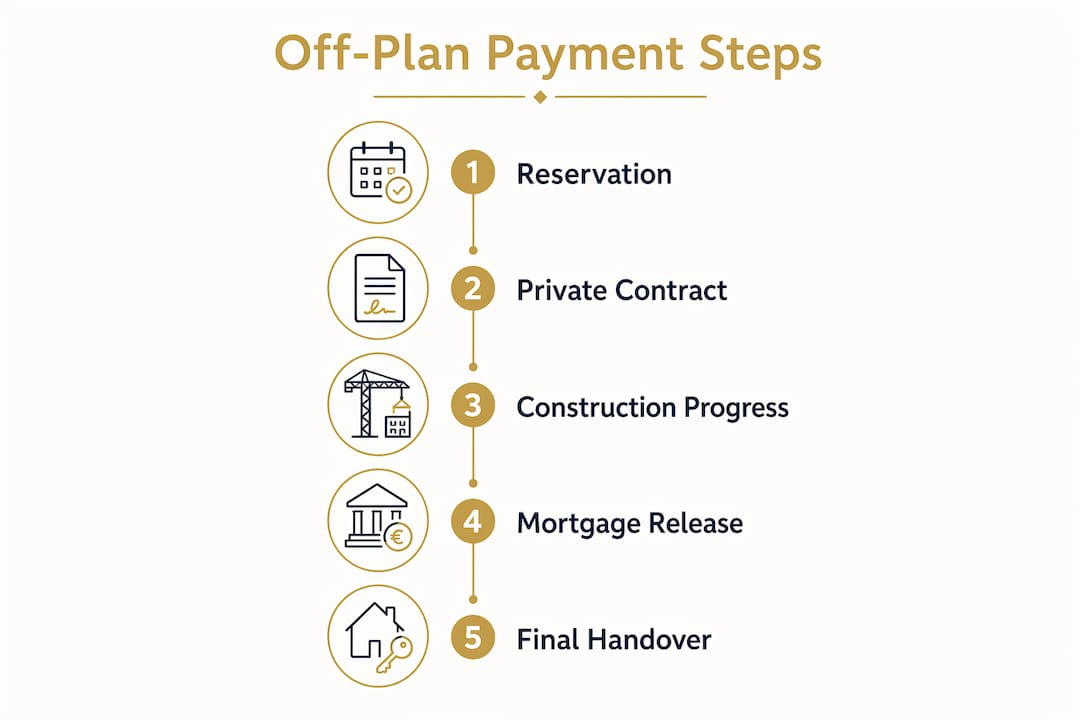
The table below shows a typical payment schedule for a €350,000 apartment:
| Stage | Percentage | Approximate amount |
|---|---|---|
| Reservation | 1–2% | €3,500–€7,000 |
| Private contract signing | 10–20% | €35,000–€70,000 |
| Construction milestones (2–4 payments) | 20–40% | €70,000–€140,000 |
| Final payment at handover | 30–40% | €105,000–€140,000 |
One critical financing reality catches many buyers off guard. Spanish banks only release mortgages at the point of signing the escritura (the final deed of ownership), which happens at handover. This means you must fund all pre-completion milestone payments entirely from your own cash reserves. On a €350,000 property, that could mean finding €140,000 or more before your mortgage is even activated.
Construction delays of six months or longer are common across Spain. Build a timing buffer into your financial planning. If you are renting while waiting for your new home, factor in the cost of an extended tenancy. If you are selling an existing property to fund the purchase, do not time the sale to coincide exactly with the projected handover date.
Pro Tip: Request that your contract specifies a fixed completion month, not a vague quarter or year. Contracts should include a six-month grace period after that date, with daily financial penalties for any further delay. Without these clauses, you have limited leverage if the developer runs behind schedule.
What contract clauses should buyers negotiate before signing?
Off-plan private contracts typically run 15 to 30 pages and contain clauses that can either protect you comprehensively or leave you exposed. Most buyers sign without negotiating a single term. That is a mistake.
The clauses that matter most are:
- Fixed completion date: The contract must state a specific month and year, not “approximately Q3” or “subject to planning.” Vague wording gives the developer unlimited flexibility and you none.
- Grace period and penalties: A standard six-month grace period after the completion date is acceptable. Beyond that, the developer should pay you a daily penalty. Without this, delays cost you money with no compensation.
- Automatic rescission rights: If the developer fails to deliver within the grace period, you must have the contractual right to exit and receive a full refund of all payments plus interest. This should be automatic, not subject to negotiation at the time.
- Specification guarantees: The contract must include a detailed written specification of materials, finishes, and fittings. Broad developer discretion to substitute materials is a clause to remove or restrict before signing.
- Snagging rights: You have the right to inspect the property before signing the escritura. The contract should allow you to withhold a retention payment until agreed defects are corrected.
- Licences at handover: The developer must provide the Licencia de Primera Ocupación and the Cédula de Habitabilidad before you are obligated to complete. Failure to verify these licences can result in buying a property that cannot legally be occupied or connected to utilities.
Contract transparency and specificity are not optional extras. Vague terms on completion dates or material changes are the most common source of buyer disputes in Spanish off-plan transactions. An independent lawyer, not the developer’s recommended solicitor, must review and negotiate these terms on your behalf.
What are the main risks and how do you mitigate them?
Off-plan property investment in Spain carries real risks. The good news is that most are manageable with the right preparation.
Developer insolvency is the most serious risk. If a developer goes bankrupt and you have paid deposits without a valid bank guarantee, recovering your money is extremely difficult. Legal protections only function if the guarantee is documented, current, and correctly named. Buyer complacency, not legal weakness, is the primary cause of losses in this scenario.
Currency exchange risk is significant for non-eurozone buyers. Over an 18 to 36-month payment timeline, a 5% adverse exchange rate move on €280,000 of payments adds €14,000 to your total cost. Forward contracts, available through specialist FX providers, lock in an exchange rate for future payments and remove this uncertainty entirely.
The most overlooked risk in off-plan purchases is not developer fraud. It is the accumulation of small contractual weaknesses: a vague completion date here, a missing guarantee certificate there, a specification clause that gives the developer too much discretion. Each one alone is manageable. Together, they can turn a good investment into a prolonged legal dispute.
Additional risks to address before signing:
- Missing or incomplete licences: Verify the developer holds all required planning and building permissions before you pay a reservation fee. Buying without confirmed licences exposes you to demolition orders.
- Unpermitted plan changes: Developers sometimes alter layouts or specifications during construction. Your contract must restrict this or give you exit rights if changes are material.
- Contract assignment as an exit: If your circumstances change before handover, contract assignment (cesión de contrato) allows you to sell your position to another buyer, potentially at a profit if prices have risen during development. Confirm this right is included in your contract from the outset.
Pro Tip: Never pay a reservation fee before the developer can show you a confirmed building licence. A licence application is not the same as a licence granted. If the project is still awaiting planning approval, your money is at risk with no legal guarantee in place.
What documentation and steps do international buyers need?
Getting the administrative groundwork right before you pay anything saves significant time and stress later. The table below compares the notary’s role with your independent lawyer’s role, a distinction that confuses many international buyers.
| Role | Notary | Independent lawyer |
|---|---|---|
| Verifies identity | Yes | No |
| Authenticates signatures | Yes | No |
| Checks title and encumbrances | No | Yes |
| Reviews contract terms | No | Yes |
| Verifies licences and guarantees | No | Yes |
| Advises on tax obligations | No | Yes |
The notary’s role is limited to verifying identities and authenticating signatures. Due diligence on title, encumbrances, licences, and contract terms is entirely your lawyer’s responsibility. Many buyers assume the notary protects them. The notary does not.
Your administrative checklist before completing:
The NIE number (Número de Identificación de Extranjero) is mandatory for every property transaction in Spain, including signing contracts, paying taxes, and connecting utilities. Apply for it early. You will also need a Spanish bank account for payments, community fees, and utility direct debits. Account opening can take several weeks, but can be arranged via Power of Attorney if you are not in Spain. You can read more about obtaining your NIE on the Omnirealestate website.
On taxes, off-plan purchases attract VAT (IVA) at 10% on new builds, plus Actos Jurídicos Documentados (AJD) at rates that vary by region. Ongoing costs include IBI (annual property tax), community fees, and income tax if you rent the property. Budget for total purchase costs of 12 to 15% on top of the purchase price.
Key takeaways
Buying off-plan in Spain is safe when buyers demand individualised bank guarantees, negotiate specific contract terms, and complete all administrative steps before transferring any funds.
| Point | Details |
|---|---|
| Bank guarantee is non-negotiable | Demand an individualised certificate naming you and your unit before every payment. |
| Mortgage funds arrive late | Spanish banks release mortgages only at handover; fund all milestones from cash reserves. |
| Contract specificity protects you | Insist on a fixed completion date, grace period, daily penalties, and detailed specifications. |
| Currency risk is quantifiable | A 5% exchange rate move on €280,000 costs €14,000; use forward contracts to manage this. |
| NIE and bank account come first | Both are mandatory prerequisites; start the process before you sign anything. |
What I have learned from a decade of off-plan transactions on the Costa del Sol
I have watched buyers lose money on off-plan purchases in Spain, and in almost every case the problem was not the law. The law, when properly applied, is genuinely protective. The problem was that buyers trusted the developer’s sales team to guide them through a process where the developer’s interests and the buyer’s interests are not aligned.
The most common mistake I see is buyers treating the developer’s recommended lawyer as independent legal counsel. That lawyer’s primary relationship is with the developer. You need your own representation, someone who will push back on vague completion dates, demand the guarantee certificate before each transfer, and flag the licence status before you pay a penny.
The second mistake is underestimating how much cash you need before the mortgage activates. I have seen buyers commit to a purchase, sell their existing home to fund the milestones, and then face a six-month delay that leaves them renting at significant cost. Build that buffer in from day one.
Off-plan property investment in Spain, particularly in areas like Estepona, Manilva, and the broader Western Costa del Sol, offers genuine value when you buy early in a quality development. Prices during construction are typically lower than completed equivalents, and the Costa del Sol market has shown consistent demand from both lifestyle and investment buyers. But the opportunity is only worth pursuing if you approach it with the same rigour you would apply to any significant financial commitment. Patience and diligence are not obstacles to a good deal. They are how you get one.
— Nina
Explore off-plan properties on the Costa del Sol with Omnirealestate
Omnirealestate specialises in the Western Costa del Sol, covering Estepona, Manilva, Casares, Sabinillas, and Duquesa. With over a decade of local experience and a database of more than 7,500 listings, the team helps international buyers identify off-plan developments that match their investment goals and lifestyle requirements. From first enquiry through to handover, Omnirealestate provides personalised guidance on legal steps, financing options, and developer due diligence.

Whether you are looking for a luxury apartment in a new development or a villa on a golf resort, you can search current listings across the Costa del Sol directly on the Omnirealestate website. For buyers new to the Spanish market, the off-plan Costa del Sol guide is a strong starting point. Contact the team directly for tailored recommendations and up-to-date availability on new developments launching in 2026.
FAQ
What is off-plan property in Spain?
Off-plan property in Spain is a home purchased before or during construction, with payments made in stages tied to build milestones. The buyer secures the purchase with a reservation fee and a private contract before the property physically exists.
Is buying off-plan in Spain legally protected?
Yes. Law 38/1999 requires developers to provide an individualised bank guarantee covering 100% of buyer payments plus approximately 4% statutory interest. Protection only applies if the guarantee is correctly documented and names the buyer and specific unit.
How much cash do I need before my mortgage is released?
Spanish banks release mortgages only at the point of signing the escritura at handover. This means buyers must fund all pre-completion milestone payments, potentially 60 to 70% of the purchase price, entirely from their own cash reserves.
How long does an off-plan purchase take in Spain?
The standard timeline from reservation to handover runs 18 to 36 months, depending on the development stage when you buy and the developer’s construction schedule. Delays of six months or more are common, so build a buffer into your plans.
Do I need a NIE number before buying off-plan in Spain?
Yes. The NIE number is mandatory for signing contracts, paying taxes, and connecting utilities. Apply for it before you commit to a purchase, as processing can take several weeks.