



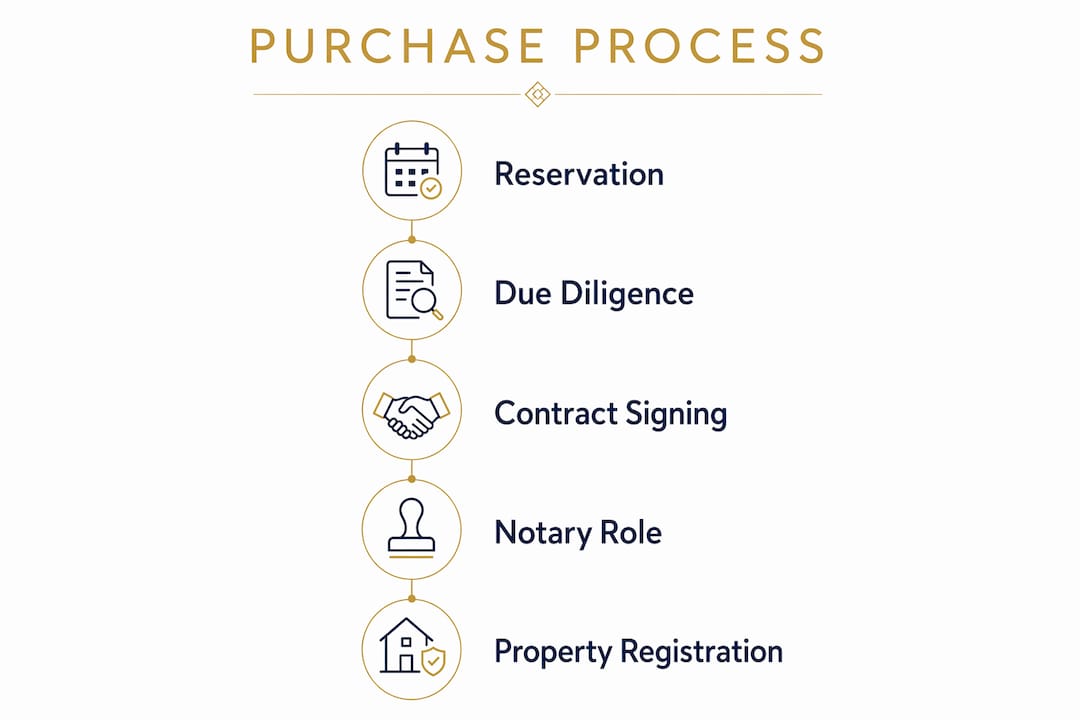
The luxury villa purchase process in Spain follows a defined sequence: reservation, due diligence, contract signing, notary deed, and land registry registration. Each stage carries distinct legal and financial obligations that differ from buying property in the UK or elsewhere in Europe. International buyers targeting coastal areas like Costa del Sol face additional layers, including non-resident tax rules, community fee liabilities, and mandatory energy certificates. Getting the sequence right from the outset protects your deposit and your ownership rights.
What must international buyers prepare before starting the process?
The single most important preparatory step is obtaining your NIE, the Número de Identificación de Extranjero. The notary will block the transaction without it. Obtaining the NIE via a Spanish consulate or police station can take 4–6 weeks, so apply well before you make an offer. Leaving it until you have found a property is one of the most common and costly delays international buyers make.
Beyond the NIE, you need to arrange your finances before committing. Spanish sellers expect proof of funds or a mortgage agreement in principle before they take a property off the market. For non-residents, Spanish mortgage lending typically requires a larger deposit than UK lenders demand, so confirm your financing structure early.

A Nota Simple is the third document to request at this stage. This is a Land Registry extract that confirms the current owner, the property’s legal description, and any charges or embargoes registered against it. Request a fresh one directly from the Registro de la Propiedad, as an outdated extract may miss recent encumbrances.
Before your viewing trip, build a luxury villa buying checklist that covers NIE status, financing confirmation, and initial property data. Buyers who arrive prepared move faster and negotiate from a stronger position.
- Apply for your NIE at least 6 weeks before your target purchase date
- Confirm financing or proof of funds before making any formal offer
- Request a fresh Nota Simple from the Registro de la Propiedad
- Appoint an independent Spanish lawyer before signing anything
Pro Tip: Appoint your lawyer before your viewing trip, not after. They can review the Nota Simple and flag problems before you fall in love with a property.
How to conduct legal and technical due diligence on a luxury villa
Due diligence on a Spanish luxury villa covers three distinct areas: the Land Registry, urban planning compliance, and financial liabilities. Treating these as separate checks is a mistake. Coordinated due diligence across all three dimensions is the safest approach, because problems often span more than one area.
Land Registry and title checks
The Nota Simple confirms ownership and reveals any mortgages, charges, or legal restrictions on the property. Your lawyer should obtain a fresh extract within days of the contract being drafted, not weeks earlier. A property can look clean on a six-month-old Nota Simple and carry a new embargo registered last month.
Urban planning and building compliance
Cross-verification between registry and urban planning is non-negotiable. Irregularities in building permits or occupation licences can block registration even when the title appears clean. On the Costa del Sol, extensions and pool additions built without permits are common. Your lawyer must verify that every structure on the plot has the correct licence.
Community fees and energy certification
Under Article 9 of Spain’s Ley de Propiedad Horizontal, community fee arrears transfer to the buyer for the year of purchase plus the three preceding years. That is a potential four years of unpaid fees that become your liability the moment you sign. Request the Comunidad de Propietarios debt certificate before the notary appointment, not on the day.
Energy Performance Certificates have been mandatory under Royal Decree 235/2013 since 2013. The seller must provide a valid certificate at signing. Certificates are valid for up to 10 years, but check the issue date. An expired certificate causes delays at the notary.
| Document | Purpose | Who provides it |
|---|---|---|
| Nota Simple | Confirms title, charges, and restrictions | Registro de la Propiedad |
| Community debt certificate | Confirms no fee arrears under Article 9 LPH | Comunidad de Propietarios |
| Energy Performance Certificate | Mandatory at signing under Royal Decree 235/2013 | Seller |
| Building licence and occupation certificate | Confirms all structures are legally built | Local town hall |
Pro Tip: Commission an independent technical survey on any luxury villa over 15 years old. Structural issues in coastal properties are rarely visible to the untrained eye and never appear in registry documents.
What are the contract stages and the notary’s role?
The Spanish buying process uses three contractual stages before you receive the keys. Understanding the difference between them protects your deposit.
- Reservation agreement. A short document and a small holding deposit, typically a few thousand euros, that takes the property off the market for an agreed period. This is not legally binding in the same way as the Arras contract, and terms vary widely.
- Contrato de Arras. The substantive pre-sale contract. You pay a deposit, usually 10% of the purchase price. If you withdraw without legal cause, you lose the deposit. If the seller withdraws, they must return double the amount. Read this contract with your lawyer before signing.
- Escritura Pública. The final title deed signed before a Spanish notary. This is the document that legally transfers ownership. The notary authenticates the identities of both parties, confirms the property details, and records the transaction.
The notary does not act as your legal adviser. Their role is to authenticate the transaction, not to protect your interests. Your independent lawyer must review all documents before the notary appointment.
Delays in delivering required documents are the most common cause of notary appointment failures. The Nota Simple, energy certificate, community debt certificate, and any mortgage cancellation papers must all be ready on the day. A missing document can force a postponement and, in the worst case, trigger deposit forfeiture if deadlines in the Arras contract are missed.
Why does property registration matter after signing?
Signing the Escritura Pública before the notary transfers ownership legally, but registration at the Registro de la Propiedad is what protects that ownership against third-party claims. The standard purchase process ends with this registration step, and skipping or delaying it leaves you exposed.
Registration creates a public record of your ownership. Without it, a fraudulent seller could theoretically sell the same property to another buyer, and the registered owner would take precedence. In practice, your lawyer should lodge the deed for registration immediately after signing.
Key points on the registration process:
- Your lawyer submits the signed Escritura Pública to the Registro de la Propiedad
- Registration typically takes several weeks, depending on the registry’s workload
- During the interim period, a preventive annotation (nota de presentación) protects your priority
- Registration fees are modest relative to the transaction value and are paid by the buyer
Do not consider the purchase complete until you hold the registered title. Chase your lawyer for confirmation that registration has been completed and request a new Nota Simple showing your name as the registered owner.
What taxes and ownership costs do international buyers face?
Tax is the area where international buyers most frequently underestimate their total costs. The Spanish property taxes guide covers the full picture, but the key obligations for luxury villa buyers are as follows.
On a resale property, buyers pay Property Transfer Tax (Impuesto de Transmisiones Patrimoniales). Rates vary by region. In Andalucía, which covers Costa del Sol, the rate is 7%. On new builds, buyers pay VAT at 10% plus Stamp Duty. For luxury properties above certain thresholds, higher rates may apply.
Community fee liabilities deserve particular attention. Under Article 9 of the Ley de Propiedad Horizontal, arrears transfer to the buyer for the year of purchase plus three preceding years. In a luxury condominium with high annual fees, this could represent a significant inherited debt.
Non-resident withholding tax is a mechanic that surprises many buyers. When you purchase from a non-resident seller, you must withhold 3% of the sale price and remit it to the Spanish tax authority within one month using Model 211. This is not a buyer’s tax. It is an advance payment of the seller’s non-resident income tax, withheld by the buyer as a legal obligation. The seller can reclaim any excess, but that process can take 6–18 months.
| Tax or cost | Rate or basis | Who pays |
|---|---|---|
| Property Transfer Tax (resale) | 7% in Andalucía | Buyer |
| VAT on new builds | 10% | Buyer |
| Non-resident withholding | 3% of sale price | Buyer withholds, remits to tax authority |
| Community fee arrears | Up to 4 years under Article 9 LPH | Buyer inherits |
| Notary and registration fees | Variable, typically 1–2% combined | Buyer |
Model your total luxury villa ownership costs before you agree a price. Buyers who calculate only the headline purchase price routinely face a shortfall at the notary.
Key takeaways
The luxury villa purchase process in Spain requires coordinated legal, financial, and technical due diligence completed in the correct sequence before notary signing.
| Point | Details |
|---|---|
| NIE is non-negotiable | Apply at least 6 weeks before your target purchase date to avoid blocking the transaction. |
| Community fee arrears transfer to you | Request the Article 9 LPH debt certificate before the notary appointment, not on the day. |
| Coordinated due diligence protects you | Check registry, urban planning, and financial liabilities together, not independently. |
| Registration completes the purchase | Lodge the Escritura Pública for registration immediately after signing to protect ownership. |
| Model all taxes before agreeing a price | Include transfer tax, withholding obligations, and potential community arrears in your budget. |
What I have learned from watching buyers get this wrong
After years of working with international buyers on the Costa del Sol, the pattern I see most often is not ignorance of the process. It is overconfidence at the wrong moment. Buyers who have done thorough research on the legal stages sometimes rush the due diligence phase because they have found a property they love and fear losing it.
Community debts are the most underestimated risk I encounter. A luxury villa in a prestigious development can carry years of unpaid community fees from a previous owner who was cash-poor despite owning an expensive asset. The debt is invisible until you request the certificate, and some buyers only ask for it days before the notary appointment. By then, the timeline is too tight to renegotiate or withdraw cleanly.
The notary appointment coordination problem is equally real. I have seen transactions collapse because the seller’s bank was slow to issue mortgage cancellation papers. The buyer had done everything right. The deal still fell apart because one document arrived two days late and the Arras deadline had passed. Build buffer time into every deadline in your pre-sale contract.
My strongest advice is to appoint a lawyer who specialises in Spanish property transactions and who communicates clearly in English. Not a generalist. Not a friend of a friend. A specialist who will chase every document, flag every discrepancy, and tell you clearly when a deal is not worth completing. That counsel is worth far more than any saving you might make by cutting corners on legal fees.
— Nina
Omnirealestate: your guide to luxury coastal villas in Spain
Omnirealestate has spent over a decade working with international buyers along the western Costa del Sol, covering Estepona, Casares, Sabinillas, Duquesa, and Manilva. The team understands the legal and financial complexities that come with buying luxury property in Spain, and provides personalised guidance from initial search through to completion.
With a database of over 7,500 listings, Omnirealestate can match your requirements quickly and connect you with properties that meet both your lifestyle and investment criteria. Whether you are looking for a frontline villa or a gated estate with sea views, the team offers direct, honest advice at every stage. Search luxury villas on the Costa del Sol or contact the Omnirealestate team to arrange a personalised consultation.
FAQ
What is the NIE and why do I need it to buy in Spain?
The NIE (Número de Identificación de Extranjero) is a tax identification number required for all property transactions in Spain. Without it, the notary will not proceed with the signing.
How long does the luxury villa buying process take in Spain?
The process typically takes 2–4 months from offer to completion, depending on due diligence findings, financing arrangements, and document coordination with the notary.
What is the Contrato de Arras and what happens if I withdraw?
The Contrato de Arras is the pre-sale contract where you pay a deposit, usually 10% of the purchase price. If you withdraw without legal cause, you forfeit the deposit.
Do I pay tax when buying from a non-resident seller in Spain?
You must withhold 3% of the sale price and remit it to the Spanish tax authority using Model 211. This is a legal obligation, not an optional step.
What community fee risks should I check before buying a luxury villa?
Under Article 9 of the Ley de Propiedad Horizontal, you inherit community fee arrears for the year of purchase plus the three preceding years. Always request the debt certificate before the notary appointment.