



Estepona is the fastest-growing residential property market on the Costa del Sol in 2026, with prices rising 12.5% annually by march 2026, more than double Marbella’s 5.1% growth rate. That gap matters. Estepona still sits roughly 10% cheaper per square metre than Marbella, yet it is closing the distance fast. Three forces are driving this: a decade of deliberate urban regeneration, a broadening pool of international buyers that now includes remote workers and younger families, and the arrival of institutional developers who have staked serious capital on the town’s future. For investors and homebuyers weighing up the Estepona property market in 2026, understanding each driver is the difference between a well-timed purchase and a missed window.
Why is the Estepona property market growing in 2026?
The short answer is that Estepona has shed its cheaper sibling image and repositioned itself as the modern alternative to Marbella. That is not marketing language. It reflects a measurable shift in planning policy, infrastructure investment, and buyer demographics over the past decade. The town now attracts buyers who want luxury-standard living without Marbella’s price premium, and that combination is rare on the Costa del Sol. Supply has not yet caught up with demand, which is the structural reason prices are accelerating. The three core growth drivers below explain the mechanics in detail.

How urban regeneration is boosting Estepona’s property values
Urban regeneration is the foundation of Estepona’s growth story. The town council has invested consistently in the pedestrianisation of the old town, the expansion of the marina, improved cycling and walking infrastructure, and a programme of street art and public gardens that has transformed the town’s visual identity. These are not cosmetic changes. They have shifted the resident demographic toward higher-income buyers and long-stay international families, which in turn supports higher property values and stronger rental demand.
The practical effects for investors are significant:
- Marina expansion has created a premium waterfront address that attracts lifestyle buyers willing to pay above-average prices per square metre.
- Pedestrianised old town has increased footfall, supporting hospitality businesses and making short-term rental properties in the centre more commercially viable.
- Improved amenities including international schools, private medical facilities, and retail have reduced the lifestyle gap with Marbella.
- New road and transport links have made commuting to Málaga and Gibraltar more practical, widening the pool of potential residents.
The rental market reflects this directly. Short-term rental revenue grew 18.9%, with occupancy reaching 61% in the may to june 2026 period. That level of occupancy in a market that is still growing its supply base signals genuine demand, not a temporary spike. The urban planning initiatives driving this are documented and ongoing, which gives investors a degree of confidence that the trajectory will continue.
Pro Tip: When assessing a specific property for investment, check whether it sits within or adjacent to a designated urban regeneration zone. Properties inside these zones tend to appreciate faster and attract higher-quality tenants.
How does Estepona compare to Marbella on price and yield?
The price gap between Estepona and Marbella is the single most cited reason investors are entering the market now. Average prices stand at 4,954 €/m² in Estepona versus 5,501 €/m² in Marbella. That 10% discount buys you comparable lifestyle infrastructure, similar climate, and in many cases newer build quality. The narrowing price gap is itself a capital appreciation argument: as Estepona continues to close the distance, early buyers capture the differential.
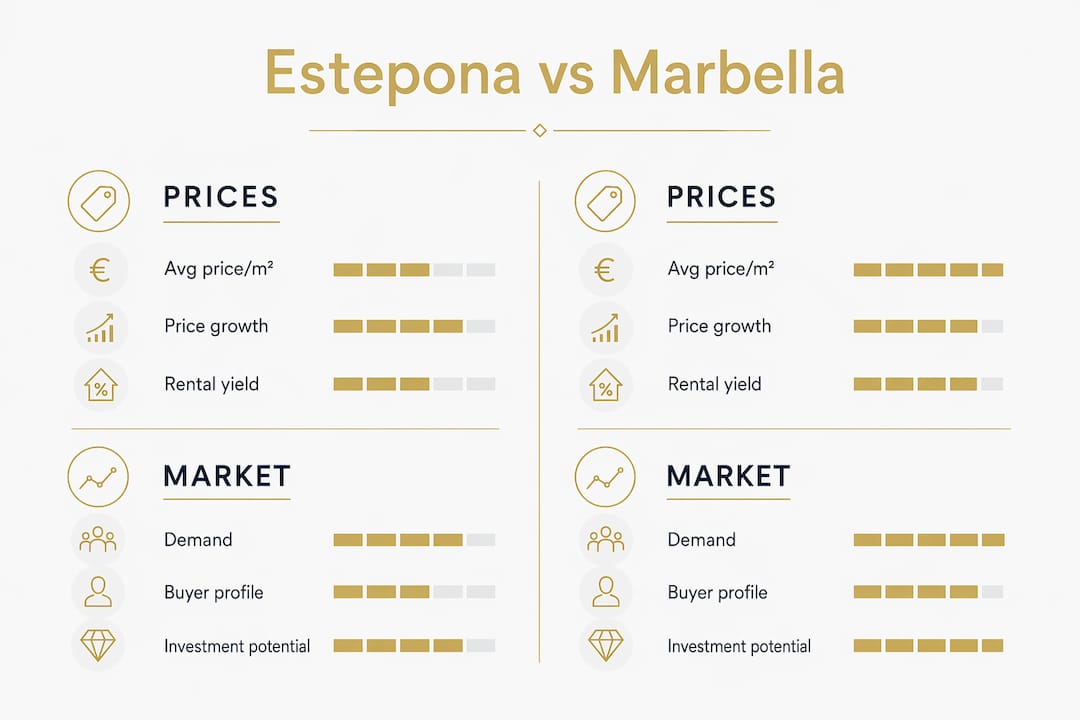
| Metric | Estepona | Marbella |
|---|---|---|
| Average price per m² | 4,954 € | 5,501 € |
| Annual price growth (2026) | 12.5% | 5.1% |
| Median property price | 515,000 € | Not publicly listed |
| Gross rental yield | ~5.8% | Lower (compressed by higher prices) |
| Short-term rental occupancy | 61% | Established but more saturated |
Rental yields tell a nuanced story. The median rent sits around €2,500 per month against a median property price of €515,000, producing a gross yield of approximately 5.8%. That yield is respectable for a coastal Spanish market, but it has not risen in line with capital values. Rental incomes have remained relatively flat even as prices have climbed. The implication is clear: capital appreciation is currently the primary return driver in Estepona, not rental income growth. Buyers who enter at the right price point capture both, but entry price discipline is non-negotiable.
Who is buying property in Estepona and why does it matter?
The buyer profile in Estepona has changed materially over the past three years. Foreign buyers account for 32.8% of residential purchases in the Málaga province, with Northern Europeans and a recovering UK buyer base leading demand. Post-Brexit adaptation has not suppressed British interest. It has filtered it toward buyers with stronger financial profiles and longer-term intentions, which is a healthier demand base than the speculative short-stay investor of earlier cycles.
The demographic shift goes beyond nationality. The appeal to international remote workers and families indicates a market that is less dependent on seasonal tourism and more anchored in primary residence and long-stay demand. That structural shift matters enormously for market resilience. A market driven by people who actually live there is far more stable than one driven by holiday-home speculation.
Key demographic factors currently lifting Estepona’s demand:
- Remote workers relocating from Northern Europe and the UK, attracted by the climate, connectivity, and lower cost of living relative to London or Amsterdam.
- International families seeking international schools, safety, and a high quality of life within a reasonable distance of Málaga airport.
- Younger buyers aged 30–45 who are priced out of Marbella but unwilling to compromise on lifestyle standards.
- Retirees from Northern Europe drawn by healthcare access, warm winters, and a well-established expat community.
- Short-term rental investors targeting the growing tourism market with VFT-compliant new builds.
This breadth of buyer types reduces the market’s vulnerability to any single demand shock. If remote working demand softens, retiree and family demand absorbs the slack. That diversification is a structural strength that Estepona did not have five years ago.
What role are institutional developers playing in Estepona’s growth?
Institutional developers entering a market is one of the clearest signals of long-term confidence. Grupo Insur, Kronos Homes, and Taylor Wimpey España have all committed to new projects in Estepona. These are not small regional builders. Their presence signals that professional capital with long investment horizons has underwritten the town’s growth trajectory. That matters to individual buyers because institutional developers bring planning expertise, build quality standards, and marketing reach that smaller developers cannot match.
The New Golden Mile, the stretch between Estepona and San Pedro Alcántara, has become a focal point for new build supply since 2021. New developments here offer modern designs, energy efficiency, and critically, eligibility for VFT registration. VFT is the Spanish short-term rental licence. Properties qualifying for VFT registration give investors a legal framework for short-term letting that older buildings often cannot access due to regulatory hurdles. This compliance advantage is a genuine differentiator for new builds over resale stock.
Key advantages of new build stock in Estepona’s current market:
- VFT eligibility enables legal short-term rental income from day one.
- Modern specifications attract higher-paying tenants and reduce maintenance costs.
- Developer warranties reduce early-stage ownership risk.
- Energy efficiency ratings are increasingly required by European mortgage lenders.
Pro Tip: Before committing to a purchase for rental income, verify that the specific property and community have VFT registration in place or a clear pathway to obtaining it. Not all new builds in Estepona automatically qualify, and the licensing process can be complex without specialist guidance.
For a detailed comparison of new build versus resale options, the new build versus resale guide from Omnirealestate covers the regulatory and financial considerations in full.
Key takeaways
Estepona’s 2026 property market growth is driven by urban regeneration, a 10% price advantage over Marbella, and a diversified international buyer base that supports long-term demand stability.
| Point | Details |
|---|---|
| Price growth outpaces Marbella | Estepona grew 12.5% annually versus Marbella’s 5.1%, with prices still 10% lower per m². |
| Urban regeneration drives value | Marina expansion, pedestrianisation, and improved amenities have raised lifestyle standards and rental demand. |
| Diverse buyer base adds resilience | Remote workers, families, and retirees from across Northern Europe reduce dependence on any single demand source. |
| Institutional developers signal confidence | Grupo Insur, Kronos Homes, and Taylor Wimpey España have committed capital, validating the long-term growth case. |
| Entry price discipline is critical | Rental yields are approximately 5.8% but have not risen with capital values, so purchase price determines return quality. |
What I actually think about Estepona’s market trajectory
The numbers are compelling, but the more interesting story is what they do not show. Estepona’s growth is not a bubble inflated by speculative buyers flipping properties in a hot market. It is a structural repricing of a town that genuinely improved itself. The pedestrianised old town, the marina, the schools, the healthcare infrastructure: these are real assets that justify higher prices. That is a fundamentally different situation from markets where prices rise on sentiment alone.
What concerns me slightly is the rental yield picture. Capital appreciation is running hard, but rental incomes have not kept pace. That means buyers entering now at full market price are taking on more capital risk than the headline yield figures suggest. The 5.8% gross yield looks attractive until you factor in management costs, community fees, and the occasional vacancy. Net yields in the 3.5–4.5% range are more realistic for most properties. That is still a reasonable return for a coastal Spanish asset with strong appreciation potential, but buyers should price it in honestly rather than relying on optimistic gross figures.
My genuine view is that Estepona offers the best risk-adjusted entry point on the Costa del Sol right now. The price gap with Marbella will continue to narrow, the urban regeneration programme has years of momentum behind it, and the buyer demographic is maturing in exactly the right direction. The window for buying at a meaningful discount to Marbella is closing. Investors who understand the Estepona price trends and act with clear-eyed entry price discipline will look back on 2026 as the right moment.
— Nina
Finding the right Estepona property with Omnirealestate
Omnirealestate has been based on the Western Costa del Sol for over a decade, specialising in Estepona, Duquesa, Casares, Sabinillas, and Manilva. The team holds a database of over 7,500 listings and works directly with buyers seeking both investment properties and primary residences.

Whether you are looking for a VFT-eligible new build on the New Golden Mile or a resale apartment in the pedestrianised old town, Omnirealestate provides tailored recommendations based on your budget, yield expectations, and lifestyle priorities. International buyers receive specialist guidance on the purchase process, legal compliance, and rental licensing. Search current Estepona properties for sale or use the property finder to match your specific requirements to available stock.
FAQ
Why are Estepona property prices rising faster than Marbella’s?
Estepona’s prices grew 12.5% annually by march 2026 compared to Marbella’s 5.1%, driven by urban regeneration, a lower starting price base, and rising international demand. The town’s infrastructure improvements have attracted a broader and wealthier buyer pool without yet reaching Marbella’s price ceiling.
Is Estepona a good place to invest in property in 2026?
Estepona offers a gross rental yield of approximately 5.8% and strong capital appreciation, making it one of the better-value investment locations on the Costa del Sol. Entry price discipline is critical because rental incomes have not risen at the same rate as capital values.
What types of buyers are driving Estepona’s property demand?
Foreign buyers account for 32.8% of residential purchases in Málaga province, with Northern Europeans and UK buyers leading demand. Remote workers, international families, and retirees are all active in the market, creating a diversified and resilient demand base.
Are new builds better than resale properties for rental income in Estepona?
New builds are generally better suited to rental income because they are more likely to qualify for VFT registration, the Spanish short-term rental licence. Older resale properties often face significant regulatory hurdles that limit their short-term letting potential.
How does Estepona’s price compare to Marbella per square metre?
Estepona averages 4,954 €/m² versus Marbella’s 5,501 €/m², a gap of approximately 10%. That discount, combined with Estepona’s faster price growth, makes it the more attractive entry point for buyers seeking both lifestyle quality and capital appreciation.