



A golf community residence in Spain is a home located within a planned, resort-style development built around one or more golf courses, offering shared leisure facilities and governed by formal community rules. These developments are distinct from ordinary apartment blocks or standalone villas. They combine private ownership with collective management of extensive shared spaces, creating a lifestyle that suits both full-time residents and those seeking a lock-up-and-leave second home. The Costa del Sol, particularly areas such as Estepona, Casares, and Marbella, concentrates the highest density of such developments in Europe, making Spain the continent’s premier destination for golf community living.
What is a golf community residence in Spain?
A golf community residence, known in the Spanish property industry as a urbanización de golf, is a residential property set within a secured, landscaped development centred around golf courses and community-managed facilities. The term covers a wide spectrum of property types, from ground-floor apartments and penthouses to semi-detached townhouses and detached villas, all sharing access to the same communal infrastructure.
What distinguishes these developments from standard residential complexes is the deliberate integration of sport, leisure, and community life into the physical design. Roads wind between fairways. Clubhouses serve as social hubs. Security gates and landscaped gardens create a resort atmosphere that persists year-round. Developments such as La Duquesa Golf, Alcaidesa Links, and Valle Romano in Estepona are well-known examples along the Western Costa del Sol.

The golf course itself is sometimes owned by the development, sometimes operated independently, and sometimes managed by a third-party operator. Buyers should clarify this distinction before purchase, as it affects access rights, green fees, and the long-term maintenance of the course.
What is the legal and community structure of golf residences in Spain?
The defining legal feature of any golf community residence is mandatory membership in the comunidad de propietarios, the owners’ community. Spanish Horizontal Property Law (Ley de Propiedad Horizontal) automatically makes every buyer a member of this legal entity the moment they complete a purchase. Membership is not optional and cannot be waived.
From a legal perspective, the defining aspect of golf community residences is this shared ownership and governance structure rather than the golf facilities themselves. The community owns and manages all common elements: roads, gardens, pools, lifts, security systems, and shared leisure facilities. Each owner holds a coeficiente de participación, a participation quota that reflects their property’s proportional share of the common elements. This quota determines both their monthly community fee and their voting weight at community meetings.
Key obligations under this structure include:
- Paying monthly community fees on time, regardless of whether you occupy the property
- Complying with community statutes and internal rules on noise, rentals, and alterations
- Attending or delegating votes at annual general meetings
- Contributing to approved repair funds and extraordinary levies
Pro Tip: Request the last three years of community meeting minutes before signing any purchase contract. These minutes reveal pending disputes, planned major works, and the financial health of the community far more clearly than any sales brochure.
Compared with a standalone villa, a golf community property offers more managed surroundings but less individual autonomy. Owners cannot make external modifications without community approval, and rental restrictions may apply depending on the statutes.
What amenities and lifestyle benefits do golf community residences offer?
Golf community living in Spain delivers a lifestyle that is genuinely difficult to replicate through standalone property ownership. The amenities available within a single development can rival those of a four-star resort, and year-round managed amenities are standard in the better-run inland and resort-style communities.
Typical amenities found across well-established Spanish golf developments include:
- Golf courses and practice facilities. Most developments offer direct access to at least one 18-hole course, plus driving ranges and putting greens.
- Clubhouses and restaurants. These serve as the social centre of the community, hosting events, dining, and informal gatherings throughout the year.
- Swimming pools. Multiple pools, often including heated options, are standard in mid-to-upper-tier developments.
- Gyms, spas, and wellness facilities. Larger developments such as those found around Sotogrande and Estepona include fully equipped fitness centres and spa treatments.
- Tennis and padel courts. Padel in particular has grown rapidly across Spanish golf communities, with courts now present in the majority of new developments.
- 24/7 security and gated access. Controlled entry points and on-site security staff are standard features that attract both permanent residents and holiday-home buyers.
The social dimension is equally significant. Golf communities attract an internationally diverse resident base, and many developments organise regular tournaments, social evenings, and seasonal events. This creates a genuine community atmosphere that appeals to retirees, remote workers, and families alike.
For buyers who do not plan to live in Spain full-time, the lock-up-and-leave model works particularly well. Professional management companies handle maintenance, cleaning, and rental administration, meaning the property can generate income and remain well-maintained during extended absences.
Pro Tip: Visit the development on a weekday in November or February, not during peak season. This reveals whether the amenities genuinely operate year-round or whether the clubhouse closes and the pools are drained the moment summer ends.
How much do community fees and other ongoing costs typically run?
Community fees in Spanish golf residences vary widely based on property size, shared amenities, and each property’s participation quota. Buyers frequently underestimate these costs, which is why understanding them before purchase is non-negotiable.
| Property type | Typical monthly fee | What is usually included |
|---|---|---|
| Studio or one-bed apartment | €80 to €150 | Gardens, basic pool, communal lighting |
| Two or three-bed apartment | €120 to €250 | Above plus security, larger pool complex |
| Townhouse | €150 to €300 | Above plus private terrace maintenance |
| Detached villa | €150 to €400 | Full resort services, 24/7 security, multiple pools |
Two properties of similar size within the same resort can carry significantly different fees depending on which shared facilities they benefit from, such as lifts, heated pools, or concierge services. This is a nuance that catches many buyers off guard.
Beyond community fees, the full cost picture includes:
- IBI (Impuesto sobre Bienes Inmuebles). Spain’s annual property tax, calculated on the cadastral value. Typically €300 to €1,500 per year depending on property value and municipality.
- Waste collection tax (tasa de basuras). Usually €100 to €300 per year.
- Buildings insurance. Community insurance covers the structure, but contents insurance is the owner’s responsibility.
- Property management fees. If using a rental management company, expect fees of around 15% of gross rental income.
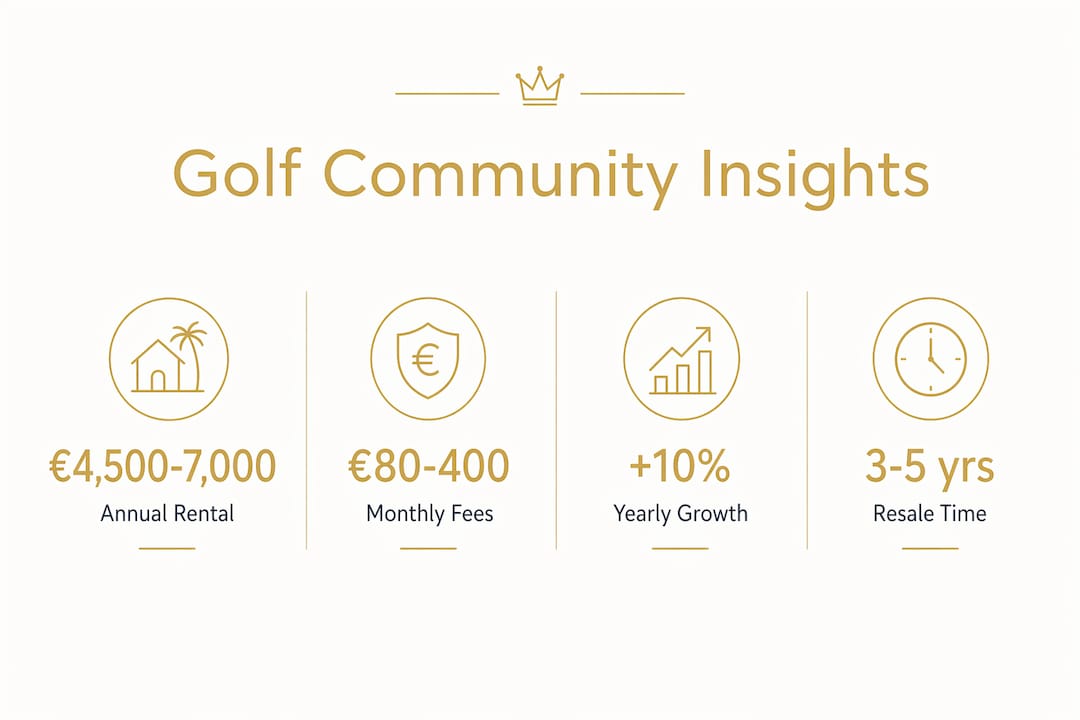
A detailed cost case study of an apartment at Condado de Alhama estimated annual community fees at €2,400 to €2,800, gross rental income at €11,000 to €14,000, and net income after all expenses at approximately €4,500 to €7,000. This illustrates how significantly running costs compress gross returns, and why realistic budgeting matters from the outset.
What are the key investment considerations for golf community residences?
Golf community residences in Spain offer a rental demand profile that differs meaningfully from purely coastal properties. Rental demand peaks in spring and autumn, specifically March to May and September to November, when golf tourists are most active. This extends the effective rental season compared with beach properties that rely almost entirely on July and August.
Golf tourism demand timing can reduce classic seasonal rental voids, making golf properties potentially more resilient investments than purely coastal homes. In practice, well-located golf properties near courses with strong reputations can achieve occupancy across 10 to 12 months in a year, though this requires active marketing and professional management.
Key investment factors to evaluate before purchase:
- Gross versus net yield. Always calculate net yield after community fees, IBI, management fees, and insurance. Gross figures are misleading without this context.
- Occupancy assumptions. Conservative projections of 60 to 70% annual occupancy are more realistic than optimistic peak-season figures.
- Course quality and reputation. Properties adjacent to well-regarded courses, such as those designed by Seve Ballesteros or Jack Nicklaus, command higher rents and resale values.
- Community financial health. A community with a well-funded reserve and no outstanding major works is a safer investment than one with deferred maintenance.
- Resale market depth. Larger, better-known developments have more active resale markets, which reduces exit risk.
For buyers considering the Costa del Sol investment market, the combination of strong international demand, a mature rental market, and year-round golf tourism creates a more stable investment environment than many other European golf destinations.
Pro Tip: Ask the selling agent for the actual rental history of the specific unit, not the development’s average. Individual unit performance varies considerably based on floor level, views, and proximity to the clubhouse.
How to approach buying a golf community residence safely
Buying a golf community residence in Spain requires more due diligence than a standard property purchase, specifically because of the community governance layer. The following steps reduce risk considerably:
- Review the community statutes in full. These govern what you can and cannot do with the property, including short-term rental restrictions that could directly affect your investment returns.
- Request a certificate of community debt. This confirms whether the seller owes any outstanding fees. Unpaid fees transfer with the property under Spanish law.
- Examine the last three years of accounts and meeting minutes. Look for patterns of fee increases, unresolved disputes, or large planned expenditures.
- Instruct an independent Spanish solicitor. A solicitor with no connection to the developer or agent will review the title deed, planning permissions, and community documentation without conflict of interest.
- Assess the management company’s track record. Well-run communities with experienced management companies maintain higher property values and better amenity standards over time.
For UK buyers in particular, the buying process in Spain involves additional considerations around currency exchange, tax residency, and post-Brexit ownership rules that a specialist agent can clarify. Working with an agent who knows the specific golf developments in your target area, rather than a generalist, makes a measurable difference to the quality of advice you receive.
Pro Tip: Never rely solely on the developer’s solicitor for legal advice, even if they offer this as a convenience. Independent legal review of community documentation has prevented many buyers from inheriting significant financial liabilities.
Key takeaways
Golf community residences in Spain combine resort-style amenities with formal community governance, and buyers who understand both dimensions make significantly better purchase decisions.
| Point | Details |
|---|---|
| Legal membership is automatic | Every buyer joins the comunidad de propietarios on completion, with binding fee and governance obligations. |
| Community fees vary significantly | Monthly fees range from €80 to €400 depending on property type, participation quota, and service level. |
| Rental seasons extend beyond summer | Golf tourism peaks in spring and autumn, supporting year-round occupancy that coastal properties rarely achieve. |
| Net yields require careful calculation | After fees, taxes, and management costs, net income on a typical apartment may be 40 to 60% of gross rental income. |
| Due diligence must cover community documents | Reviewing statutes, accounts, and meeting minutes is as important as inspecting the property itself. |
Why golf community residences reward the prepared buyer
I have spent over a decade working with buyers across the Western Costa del Sol, and the pattern I see most consistently is this: the buyers who are happiest with their golf community purchases are those who spent as much time understanding the community as they did choosing the property itself.
The golf course is the attraction, but the community is the reality you live with every day. I have seen buyers fall in love with a view and overlook a community that was carrying €200,000 in deferred maintenance costs. I have also seen buyers walk away from apparently perfect properties because the community statutes banned short-term rentals entirely, which killed the investment case they had built.
What I find genuinely underappreciated is the lifestyle resilience these developments offer. A well-run golf community in Estepona or Casares operates year-round in a way that a seasonal beach complex simply does not. The gym is open in January. The restaurant is busy in November. That consistency has real value for both residents and investors.
My honest advice is to treat the community fee not as an inconvenience but as a quality signal. A development charging €250 per month with well-maintained gardens, a heated pool, and active security is often better value than one charging €100 with crumbling communal areas and no reserve fund. You pay for what you get, and the communities that cut corners on maintenance always show it within five years.
For anyone seriously considering a golf property in Casares or the wider Costa del Sol, the investment case is genuinely strong in 2026, but only for buyers who go in with clear eyes about the full cost of ownership.
— Nina
Explore golf community properties with Omnirealestate
Omnirealestate specialises in golf community properties across the Western Costa del Sol, with particular depth in Estepona, Casares, Sabinillas, and Manilva. Their database of over 7,500 listings includes everything from lock-up-and-leave apartments on established golf resorts to luxury villas with direct fairway access.

Whether you are buying for lifestyle, investment, or both, the Omnirealestate team brings over a decade of on-the-ground knowledge to every search. Browse homes for sale in Estepona to see current golf community listings, or explore properties in Casares for some of the region’s most sought-after golf resort addresses. Contact Omnirealestate directly for tailored recommendations and honest guidance on community fees, legal obligations, and realistic investment returns.
FAQ
What is a golf community residence in Spain?
A golf community residence in Spain is a home within a resort-style development built around one or more golf courses, with shared amenities and formal community governance. Owners automatically become members of the comunidad de propietarios and pay monthly community fees.
How much are community fees in Spanish golf resorts?
Community fees typically range from €80 to €250 per month for apartments and €150 to €400 per month for villas, depending on property size, participation quota, and the level of shared services provided.
Can I rent out my golf community property in Spain?
Most golf community properties can be rented out, but community statutes may impose restrictions on short-term lets. Always review the statutes before purchase, as rental bans or limitations directly affect investment returns.
Are golf properties in Spain good investments?
Golf properties can deliver net annual income of €4,500 to €7,000 on a mid-range apartment after all costs, with rental demand extending across spring and autumn golf seasons. Net yields depend heavily on community fees, management costs, and realistic occupancy assumptions.
What due diligence is needed before buying a golf community property?
Buyers should review community statutes, request a certificate of outstanding community debt, examine three years of accounts and meeting minutes, and instruct an independent Spanish solicitor to verify title, planning permissions, and all community documentation.