



Financing a property purchase in Casares, Spain, is defined by two non-negotiable cash requirements: a 30–40% equity deposit and an additional 10–13% to cover purchase taxes and fees. Spanish banks lend 60–70% loan-to-value to non-resident buyers, calculated against whichever figure is lower: the purchase price or the bank’s own valuation. That distinction matters enormously, because a conservative valuation can shrink your mortgage offer and leave you short on completion day. Spain’s Mortgage Credit Act adds a mandatory 10-day cooling-off period after you receive the European Standardised Information Sheet (FEIN), giving you time to compare offers before signing. Mortgage approval for non-residents typically takes 6–12 weeks from application to deed.
What are the key cash and mortgage requirements for financing property in Casares?
Non-resident buyers in Casares must prepare significantly more cash than buyers in their home countries typically expect. The mortgage covers 60–70% of the property value, which means you fund the remaining 30–40% from your own resources. On top of that equity contribution, purchase taxes and fees add a further 10–13% of the purchase price, paid entirely in cash at completion.
The single most common planning error is assuming the bank values the property at the agreed purchase price. Banks commission an independent valuation, and if that figure comes in below the purchase price, the 60–70% loan-to-value ratio applies to the lower number. A buyer purchasing a €400,000 property that the bank values at €370,000 receives a maximum mortgage of around €259,000, not €280,000. That gap of €21,000 must come from your own funds, on top of the equity and taxes already budgeted.

Under Spain’s 2019 Mortgage Credit Act, banks cover most mortgage setup costs including notary fees, registry fees, and stamp duty. Buyers pay the property valuation fee directly, which is a predictable and relatively modest expense. This shift in cost allocation since 2019 reduces the surprise charges at completion, but it does not reduce the equity and tax burden.
The clearest way to plan your cash position is to add three figures together:
- Equity deposit: 30–40% of the conservative (lower) valuation estimate
- Purchase taxes and transfer fees: 10–13% of the purchase price
- Valuation fee: paid directly by the buyer; amount varies by property value
Pro Tip: Model your cash requirement using a valuation 5–10% below the agreed purchase price. If the numbers still work, you are protected against the most common shortfall scenario.
Buyers who treat the purchase price and the bank valuation as identical figures consistently underestimate their cash requirement. Conservative modelling is not pessimism. It is the standard practice of every experienced buyer in the Spanish market.
Which documents and legal steps do buyers face when financing in Casares?
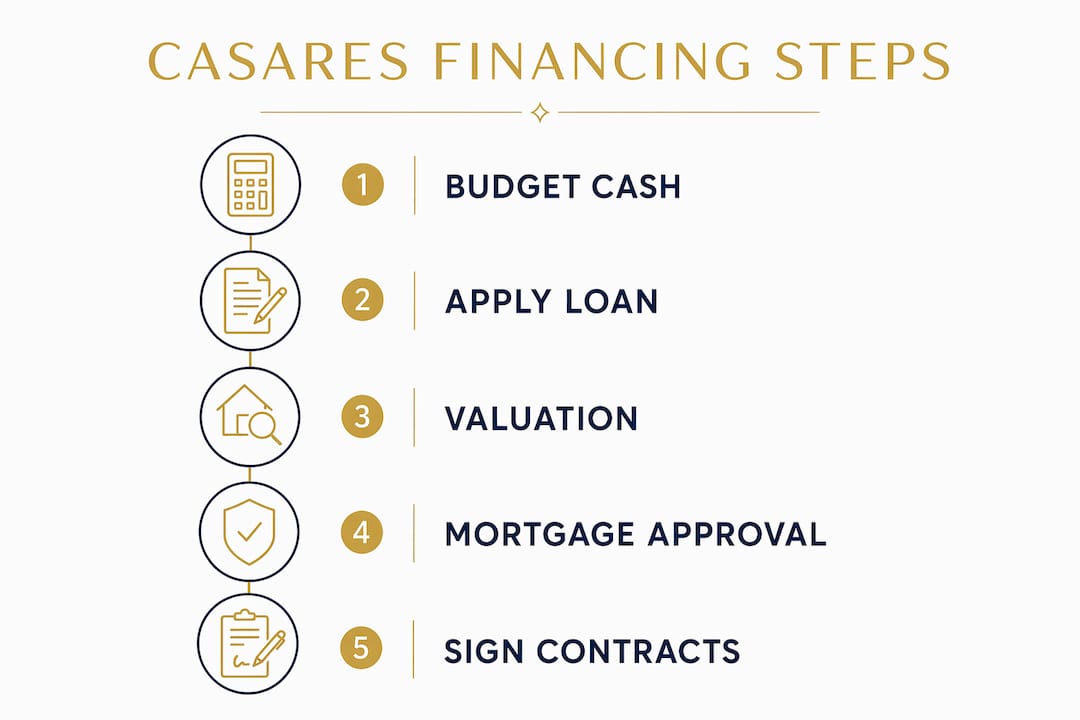
The Spanish mortgage process follows a defined sequence, and skipping steps creates legal and financial risk. Non-resident buyers must gather documents before approaching any lender, because incomplete applications cause delays that can push past deposit contract deadlines.
The core documents required are:
- NIE number (Número de Identificación de Extranjero): your Spanish tax identification number, without which no property transaction can proceed.
- Proof of income: recent payslips, tax returns, or audited accounts for self-employed buyers.
- Bank statements: typically three to six months of statements from your primary account.
- Spanish bank account: most lenders require mortgage repayments to be drawn from a Spanish account.
- Property details: the preliminary purchase agreement or listing documentation for the specific property.
Once the lender approves your application in principle, they commission the independent valuation. After the valuation clears and the full mortgage offer is prepared, you receive the FEIN. Spain’s 2019 Mortgage Credit Act mandates a 10-day cooling-off period after FEIN receipt before you can sign the mortgage deed. This period exists so buyers can compare offers and seek independent legal advice without pressure.
The total timeline from application to mortgage deed signing runs approximately 6–12 weeks for non-residents. That window must align with the terms of your deposit contract. If your deposit agreement requires completion within eight weeks and the mortgage takes ten, you face either a contract breach or a rushed decision during the FEIN cooling-off period. Aligning these timelines from the outset is one of the most practical things an experienced local agent can help you manage.
Pro Tip: Request a realistic mortgage timeline estimate from your lender before signing any deposit agreement. Build in a two-week buffer beyond the lender’s estimate.
What mortgage options and interest rates apply to Casares property buyers?
Spain’s mortgage market in 2026 offers both fixed and variable rate products, with fixed rates now dominant. In april 2026, 62.9% of new residential mortgages in Spain were fixed rate, reflecting borrower preference for payment certainty in a period of rate movement. The average interest rate on new mortgages stood at approximately 2.90%, with an average term of around 25 years.
Non-resident buyers face slightly higher rates than Spanish residents on equivalent products. Lenders view non-residents as carrying additional risk, partly because enforcing a mortgage across borders is more complex. The difference is typically modest but worth factoring into affordability calculations.
The table below compares the two main mortgage structures available to international buyers in Casares:
| Feature | Fixed rate mortgage | Variable rate mortgage |
|---|---|---|
| Rate certainty | Payments fixed for full term | Payments change with Euribor |
| Current market share | 62.9% of new mortgages | 37.1% of new mortgages |
| Typical term | Up to 25 years | Up to 25 years |
| Non-resident availability | Yes, at slightly higher rates | Yes, at slightly higher rates |
| Best suited to | Buyers prioritising budget certainty | Buyers expecting rates to fall |
Many Spanish lenders bundle life insurance and home insurance with their mortgage products, offering a rate discount in exchange. The discount can appear attractive, but the bundled insurance premium sometimes costs more than the rate saving over the mortgage term. Always request a standalone insurance quote and compare the total cost over five years before accepting a bundled product.
How should buyers structure deposit contracts to protect their financing?
The deposit contract, known in Spain as an arras contract, is the point where most financing risk concentrates. Signing an arras contract without a financing clause means that if your mortgage application is rejected, you forfeit the deposit. Signing without a financing contingency is the single most avoidable and costly mistake non-resident buyers make.
A financing clause in the arras contract states that the buyer’s obligation to complete is conditional on mortgage approval. If the lender declines the application or the valuation falls short, the buyer recovers the deposit. Without this clause, the seller keeps the deposit regardless of the reason for non-completion.
Key practices to protect your position:
- Include an explicit financing condition in every arras contract before signing.
- Set the completion deadline at least two weeks beyond your lender’s estimated mortgage timeline.
- Do not sign the arras contract before receiving at least a preliminary indication from your lender.
- Delay irreversible commitments until after FEIN receipt and valuation clearance where possible.
Practitioners consistently advise delaying irreversible deposit agreements until after the FEIN has been received and the bank valuation has cleared. This sequence gives buyers the full benefit of the mandatory cooling-off period and removes the risk of forfeiting a deposit due to a valuation shortfall or lender decline.
Independent legal counsel is not optional for non-resident buyers. A Spanish property lawyer reviews the arras contract, confirms the financing clause is enforceable, and checks the property’s legal status before you commit funds. The cost is modest relative to the protection it provides.
Pro Tip: Ask your lawyer to confirm that the financing clause specifies the minimum loan amount and interest rate you require. A vague clause may not protect you if the lender offers a mortgage on materially worse terms than expected.
What financing options exist for investment or development properties in Casares?
Standard residential mortgages cover the majority of property purchases in Casares, but investment buyers and those pursuing development projects need different financing structures. Two alternatives are relevant: development finance and bridging loans.
Development finance provides phased funding aligned with construction milestones. Funds are released upon completion of defined stages such as foundation work, structural completion, and fit-out. This structure suits buyers purchasing land and commissioning a build, or investors acquiring a property requiring substantial renovation before it can be sold or let.
Key points for investment and development financing:
- Loan-to-value ratios for development finance are typically more conservative than residential mortgages.
- Lenders require detailed project plans, planning permissions, and cost schedules before approving funds.
- Phased drawdown means interest accrues only on funds released, reducing carrying costs during construction.
Bridging loans serve a different purpose. They provide short-term finance to complete a purchase quickly, typically where a buyer is waiting for funds from a property sale elsewhere. The exit strategy must be clearly defined before taking a bridging loan.
Exit strategies for investment properties in Casares typically follow one of three paths:
- Resale: complete the project and sell at a profit, repaying the development loan from proceeds.
- Refinance: convert the development loan to a standard residential or buy-to-let mortgage once the property is habitable.
- Rental income: retain the property and service the mortgage from rental returns, a viable strategy given Casares’s position on the Costa del Sol investment corridor.
Each exit strategy carries different tax and regulatory implications in Spain, which makes early legal and financial planning non-negotiable for investment buyers.
Key takeaways
Financing a property purchase in Casares requires preparing 30–40% equity plus 10–13% in purchase costs, securing a financing clause in your deposit contract, and allowing 6–12 weeks for mortgage approval.
| Point | Details |
|---|---|
| Cash requirement | Budget 30–40% equity plus 10–13% in taxes and fees, all paid in cash. |
| Valuation risk | Banks lend against their own valuation, not the purchase price; model conservatively. |
| Legal cooling-off | Spain’s FEIN gives you 10 days to compare offers before signing the mortgage deed. |
| Deposit protection | Always include a financing clause in the arras contract before committing any deposit. |
| Investment options | Development finance and bridging loans serve project buyers beyond standard mortgages. |
What I have learned about financing property in Casares
The valuation shortfall problem is the one that catches buyers most off guard, and I have seen it happen more than once. A buyer agrees a price, feels confident about their deposit, and then discovers the bank values the property at €30,000 less than expected. Suddenly the mortgage is smaller, the cash gap is larger, and the arras deadline is approaching. The fix is simple: always model your cash requirement on a valuation below the agreed price, not equal to it.
The FEIN cooling-off period is genuinely useful, not just a bureaucratic formality. Ten days is enough time to get a second mortgage quote, have your lawyer review the terms, and decide whether the offer is right for you. Buyers who rush through this stage because they feel pressure from the seller or the timeline almost always regret it. Patience here costs nothing and can save thousands.
My strongest advice for any international buyer financing in Casares is to appoint an independent Spanish property lawyer before signing anything. Not after. Not at the same time as the arras. Before. The lawyer’s job is to protect your interests, and that protection only works if they are involved from the start.
— Nina
Financing your Casares purchase with Omnirealestate
Omnirealestate has spent over ten years working with buyers across Casares, Estepona, Duquesa, and Manilva, which means the team understands how Spanish mortgage timelines, valuations, and deposit contracts interact in practice.

Whether you are searching for a residential home or an investment property, Omnirealestate’s database of over 7,500 listings gives you immediate access to the full range of properties for sale in Casares. The team provides guidance on financing property in Spain alongside tailored property recommendations, so you approach lenders with a clear picture of the market and your options. Contact Omnirealestate to start your search with specialists who know this market from the inside.
FAQ
How much cash do I need to buy property in Casares as a non-resident?
Non-resident buyers need 30–40% of the property value as an equity deposit, plus 10–13% of the purchase price to cover taxes and fees. Both amounts must be paid in cash, as the mortgage does not cover these costs.
What is the FEIN and why does it matter for my mortgage?
The FEIN is the European Standardised Information Sheet, a document your lender must provide before you sign a mortgage deed. Spain’s Mortgage Credit Act gives you a mandatory 10-day cooling-off period after receiving it, during which you can compare offers and seek legal advice.
Can I lose my deposit if my mortgage is rejected in Spain?
Yes, if you sign an arras deposit contract without a financing clause. A financing clause makes your obligation to complete conditional on mortgage approval, protecting your deposit if the lender declines your application or the valuation falls short.
What mortgage interest rates apply to non-residents buying in Casares?
The average rate on new residential mortgages in Spain was approximately 2.90% in april 2026, with 62.9% of new mortgages on fixed rates. Non-resident buyers typically pay slightly higher rates than Spanish residents on equivalent products.
Is development finance available for investment projects in Casares?
Development finance is available in Spain for land acquisition and construction projects, with funds released in phases aligned to construction milestones. Buyers pursuing this route need detailed project plans, planning permissions, and a clear exit strategy before lenders will approve funding.