



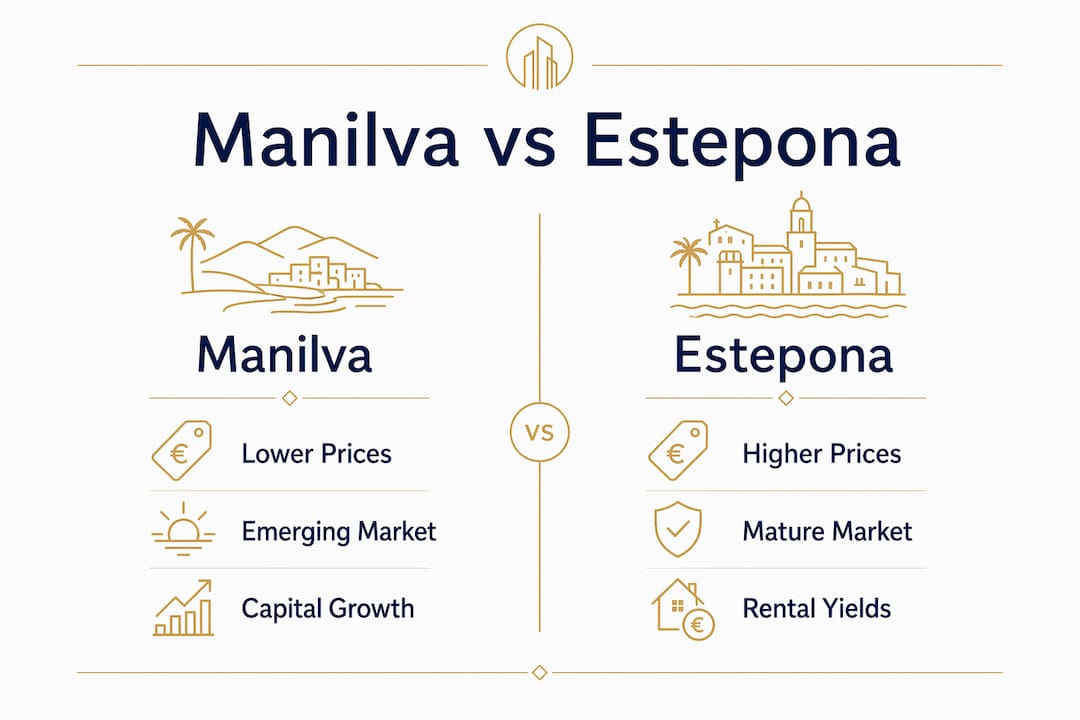
Manilva and Estepona represent two distinct property markets on the Western Costa del Sol, and understanding the manilva versus estepona property difference is the single most important step for any international buyer entering this region. Manilva’s prices sit 25–40% below Estepona’s, making it the coast’s most significant value opportunity. Estepona, by contrast, has matured into a lifestyle destination competing directly with Marbella. Both towns offer coastal living, but they serve fundamentally different buyer priorities. Omnirealestate, with over a decade based in Duquesa and a database of more than 7,500 listings, works across both markets daily.
How do property prices compare between Manilva and Estepona?
The price gap between these two towns is the defining feature of the Manilva versus Estepona property difference. The Costa del Sol market consolidates into three tiers in 2026: Manilva at the affordable end, Estepona in the premium segment just below Marbella, and Marbella itself at the top. That structure matters because it tells you where each market is heading, not just where it sits today.
Price per square metre across zones
Manilva’s average price per square metre ranges from approximately €3,110 in San Luis de Sabinillas to €3,618 in Castillo de la Duquesa as of may 2026. Estepona commands noticeably higher figures, reflecting its more developed infrastructure and stronger demand from lifestyle buyers. The monthly household cost in Estepona averages around €1,961, compared to approximately €1,336 in Manilva. That gap of over €600 per month compounds significantly over a full year of ownership.
Property types and availability

Both towns offer apartments, townhouses, and villas, but the mix differs. Estepona carries a stronger supply of new build apartments, particularly around its marina district and the New Golden Mile corridor. Manilva’s stock leans more towards resale townhouses and villas, with pockets of new development emerging near Duquesa port. For buyers seeking coastal homes in Manilva at lower entry prices, the resale market offers genuine value. Estepona’s new build pipeline suits buyers who want turnkey properties with modern specifications and developer warranties.
| Feature | Manilva | Estepona |
|---|---|---|
| Average price per sq m | €3,110–€3,618 | Higher, premium tier |
| Monthly household cost | Approx. €1,336 | Approx. €1,961 |
| Dominant property type | Resale townhouses, villas | New build apartments, villas |
| Market stage | Emerging, value-led | Mature, lifestyle-led |
| Price vs Marbella | Significantly lower | Approx. €78 below Marbella |
Pro Tip: Always check whether parking spaces and storage rooms carry separate title deeds. In the Málaga region, these ancillary spaces often have their own Land Registry entries. Buying a property without confirming these are included in the sale can leave you liable for unexpected debts attached to those separate fincas.
What lifestyle differences influence desirability in Manilva and Estepona?
Lifestyle is where the two towns diverge most sharply, and for many buyers it matters more than price alone. Estepona’s urban regeneration has transformed it into a vibrant town with an expanded marina, pedestrianised streets, and a cultural scene that competes with Puerto Banús for lifestyle-led tourism. The town centre feels genuinely alive year-round, not just in summer.
Manilva offers something different. It is quieter, more residential, and increasingly popular with buyers priced out of Estepona and Sotogrande. Proximity to Sotogrande drives demand westward as luxury prices in that enclave rise, pushing buyers towards Manilva’s more accessible market. The area around Duquesa port has a genuine community feel, with a mix of Spanish residents and established international families.
Key lifestyle factors that shape buyer choices between the two towns:
- Schools and education: Estepona has better access to international schools, including options along the New Golden Mile. Manilva families often travel to Sotogrande or Estepona for international schooling.
- Transport and connectivity: Both towns connect via the AP-7 motorway and the A-7 coastal road. Estepona sits closer to Marbella and Málaga airport. Manilva is nearer to Gibraltar airport, which suits buyers from the UK.
- Healthcare: Estepona has a larger public hospital and a wider range of private clinics. Manilva relies on local health centres and proximity to Estepona’s facilities.
- Dining and leisure: Estepona’s town centre and marina offer a broader restaurant and bar scene. Manilva’s Duquesa port has a compact but charming selection of waterfront restaurants.
- Community character: Estepona attracts a cosmopolitan mix of buyers from across Europe and beyond. Manilva draws buyers who prefer a quieter pace and a stronger sense of neighbourhood.
For buyers who want a full-service lifestyle with restaurants, shops, and cultural events on their doorstep, Estepona wins clearly. For those who value tranquillity, lower costs, and a community that has not yet been fully discovered, Manilva is the more compelling choice.
What are the investment potentials and rental yields in Manilva versus Estepona?
Investment returns differ between the two towns in ways that reflect their market maturity. Estepona delivers gross rental yields of around 4–6%, with two-bedroom apartments in the marina district achieving approximately 5.4%. That is a solid return for a mature coastal market, and the short-term rental demand is consistent given Estepona’s year-round tourism appeal.
Manilva’s yields are harder to pin down precisely because the short-term rental market is less developed. The trade-off is clear: lower entry prices mean a lower absolute cost of ownership, but the rental demand pool is smaller. Buyers targeting capital growth rather than immediate income will find Manilva more interesting. Manilva mirrors Estepona’s growth trajectory from roughly 15 years ago, when Estepona was still considered the affordable alternative to Marbella.
| Investment metric | Manilva | Estepona |
|---|---|---|
| Market stage | Emerging, value play | Mature, income-generating |
| Gross rental yield | Lower, developing market | Approx. 4–6% |
| Capital growth potential | Higher upside, longer horizon | Steady, more predictable |
| Liquidity on exit | Slower, smaller buyer pool | Faster, larger buyer pool |
| Entry price advantage | Significant (25–40% lower) | Premium pricing, lower risk |
Estepona suits buyers who want reliable rental income and a faster exit if they choose to sell. Manilva suits buyers with a longer investment horizon who are willing to accept lower near-term liquidity in exchange for stronger capital appreciation potential. Exploring rental investment property in both markets before committing is the most practical way to test your assumptions against live data.
What legal checks should buyers make in Manilva and Estepona?
Legal due diligence is non-negotiable in both towns, but Manilva presents specific risks that buyers must address before signing anything. Villas on rustic land carry stricter mortgage conditions, with loan-to-value ratios typically between 50–70%, compared to 80% for urban properties. That difference directly affects how much capital you need to bring to the table.
Land classification is the first thing to verify. A property described as a villa may sit on rustic land, which limits what you can build, extend, or modify. Urban classification gives you far more flexibility and better financing terms. Your solicitor must check the Catastro and Land Registry records before you proceed.
Parking spaces and storage rooms in the Málaga region frequently carry separate Land Registry entries. If the sales contract does not explicitly include these fincas, you may complete the purchase only to discover that the parking space belongs to someone else, or carries its own outstanding debts. This is a common oversight that costs buyers time and money to resolve.
Pro Tip: Instruct an independent Spanish solicitor before you sign any reservation agreement. The vendor’s agent cannot act in your interest. A solicitor will check the nota simple, confirm land classification, verify all fincas included in the sale, and flag any outstanding charges or planning irregularities before you commit.
Estepona’s urban properties carry fewer classification risks, but buyers should still verify planning permissions on any property with extensions or modifications. The town’s rapid development means some older properties have had work done without full licences.
Key takeaways
Manilva offers lower entry prices and stronger capital growth potential, while Estepona delivers higher rental yields, greater liquidity, and a more developed lifestyle offering.
| Point | Details |
|---|---|
| Price gap is significant | Manilva sits 25–40% below Estepona, creating a clear value entry point. |
| Lifestyle drives Estepona demand | Estepona’s marina, dining scene, and schools attract lifestyle-led buyers year-round. |
| Manilva suits growth investors | Lower prices and Sotogrande spillover demand make Manilva a strong long-term play. |
| Legal checks differ by location | Rustic land in Manilva restricts financing; always verify land classification first. |
| Rental yields favour Estepona | Estepona marina apartments achieve gross yields of approximately 5.4%. |
My honest view on choosing between these two markets
I have watched both markets closely for years, and the question I hear most often is: “Which is the better buy?” The honest answer is that it depends entirely on what you are buying it for.
Estepona is not the bargain it was a decade ago. It has earned its premium, and buyers who purchased there five or six years ago have seen strong gains. The lifestyle is genuinely excellent, the infrastructure is solid, and the rental market is real. If you want income now and a straightforward exit later, Estepona is the more dependable choice.
Manilva is where I see the more interesting opportunity right now. The Sotogrande effect is real. As prices in that enclave push higher, buyers and renters are looking west, and Manilva is the first stop. The Manilva lifestyle and property offer is still underpriced relative to what the area will likely become. Buyers who are patient and willing to hold for five or more years stand to benefit considerably.
The mistake I see buyers make is treating this as a binary choice based purely on price. The right question is: what does your life look like in this property? If you need schools, a social scene, and easy access to Málaga, Estepona wins. If you want space, quiet, and value, Manilva is worth serious consideration.
— Nina
How Omnirealestate can help you find the right property
Omnirealestate has been based in Duquesa for over ten years, working across Manilva, Estepona, Sabinillas, Casares, and Sotogrande. The team knows both markets in detail, from pricing trends to the legal quirks that catch buyers off guard.

With a database of over 7,500 listings, Omnirealestate can match your budget, lifestyle needs, and investment goals to the right property in the right location. Whether you are drawn to Estepona apartments and villas or exploring value opportunities in Manilva, the team provides honest, specific guidance at every stage. Use the property search tool to browse current listings across both towns, or contact the team directly for a personalised shortlist based on your criteria.
FAQ
What is the main property price difference between Manilva and Estepona?
Manilva’s property prices are typically 25–40% lower than Estepona’s. In may 2026, Manilva’s average price per square metre ranges from €3,110 to €3,618 depending on the zone.
Is Estepona a good place to invest for rental income?
Estepona delivers gross rental yields of approximately 4–6%, with marina district apartments achieving around 5.4%. Its year-round tourism demand makes it one of the stronger short-term rental markets on the Costa del Sol.
What legal risks should I know about when buying in Manilva?
Villas on rustic land in Manilva carry loan-to-value ratios of 50–70%, compared to 80% for urban properties. Always verify land classification and check whether parking spaces carry separate title deeds before signing.
Which town suits a long-term capital growth strategy better?
Manilva is the stronger long-term capital growth play. It mirrors Estepona’s trajectory from roughly 15 years ago and benefits from increasing demand driven by rising prices in nearby Sotogrande.
Can I find both new build and resale properties in these towns?
Estepona has a strong pipeline of new build apartments, particularly along the New Golden Mile. Manilva’s market leans towards resale townhouses and villas, with some new development around Duquesa port.