



Negotiating offers on a property sale in Spain is defined as the structured process of exchanging price and terms between buyer and seller until both parties reach a binding agreement. The typical negotiation margin sits between 5% and 15% of the asking price, though stalled listings can yield reductions of up to 18%. Success depends on three things: verified market data, professional due diligence, and a clear understanding of what the seller actually wants. This guide covers every stage of that process, from reading the market to signing the arras contract, with specific tactics for international buyers and sellers on the Costa del Sol.
What are typical negotiation margins on spanish property?
Negotiation margins in Spain vary significantly depending on how long a property has been listed. For fresh listings under three months old, buyers should expect to open 6–8% below asking price and settle at 3–5% below. Properties listed over 90 days attract average discounts of 12–18%, reflecting reduced seller confidence and accumulated carrying costs. That gap matters enormously when you are deciding how aggressively to open.
Market demand also shapes what is achievable. In high-demand areas like Estepona and Duquesa, where stock turns quickly, sellers hold more leverage. In slower micro-markets such as inland Manilva or certain resale apartment blocks, buyers gain the upper hand faster. Checking the Costa del Sol market trends for your specific area before making any offer is not optional. It is the foundation of every credible bid.

Seller motivation is the variable most buyers underestimate. Identifying a seller’s circumstances, such as multiple heirs needing a quick liquidation, can unlock discounts of 15–20%. That is significantly more than you would achieve through price alone. A motivated seller values speed and certainty over squeezing out the last euro.
| Scenario | Typical Opening Offer | Realistic Settlement |
|---|---|---|
| Fresh listing (under 3 months) | 6–8% below asking | 3–5% below asking |
| Stalled listing (3–6 months) | 10–12% below asking | 6–8% below asking |
| Long-stagnant listing (over 90 days) | 12–15% below asking | Up to 18% below asking |
| Motivated seller (heirs, relocation) | 15% below asking | 15–20% below asking |
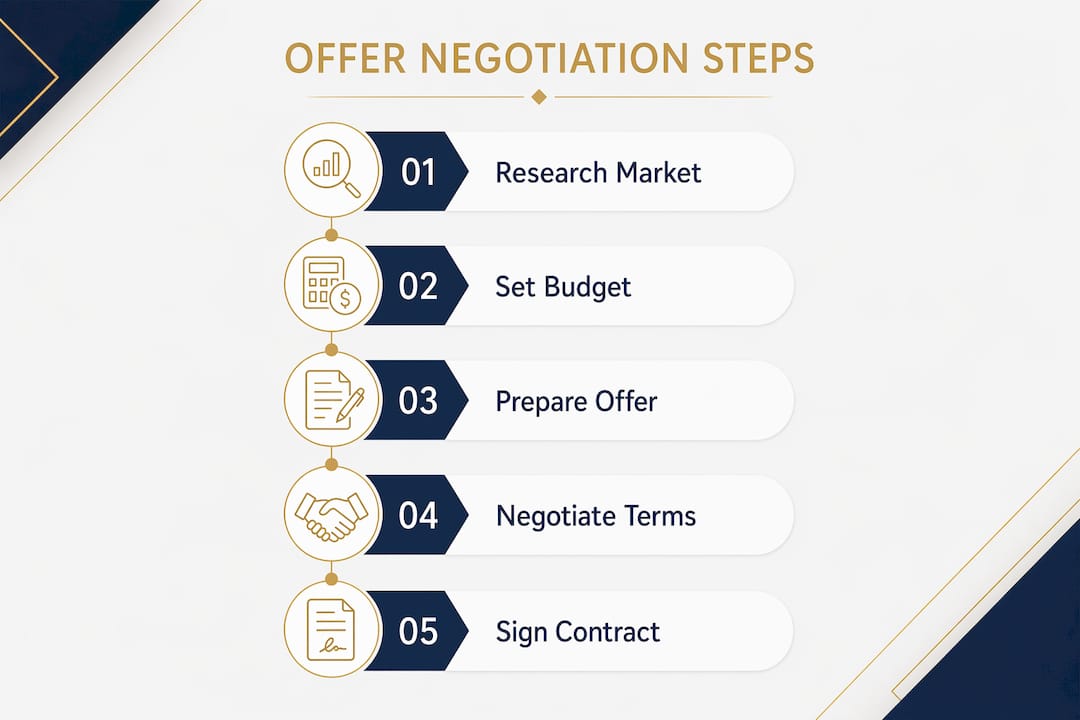
How to prepare before making a property offer in spain
Preparation is the single biggest differentiator between buyers who negotiate well and those who overpay. The steps below are not bureaucratic formalities. Each one gives you concrete leverage at the table.
- Obtain your NIE number. Without a Número de Identificación de Extranjero, you cannot legally complete a purchase in Spain. Having it ready signals seriousness to sellers.
- Arrange proof of funds or a mortgage agreement in principle. Sellers prefer deal certainty over higher offers with complex conditions. Showing you can complete quickly is a negotiating asset in itself.
- Commission a professional inspection. Construction defects or moisture issues revealed by a technical survey can justify price reductions of 10–20%. This is not just due diligence. It is ammunition.
- Gather real transaction data, not portal prices. Listing prices on portals are often inflated figures. Local agents with access to actual sales records give you the accurate baseline you need to justify your offer.
- Understand the full purchase costs. Spanish buying fees and taxes typically add 10–13% on top of the purchase price. Factor this into your maximum budget before you open negotiations.
- Prepare a formal written offer document. Include your proposed price, conditions, timeline, and any items you expect to be included in the sale.
Pro Tip: Hire a buyer’s agent who specialises in your target area. They have access to real sales data, know which sellers are motivated, and can negotiate on your behalf without the emotional attachment that costs buyers money.
What are the best strategies to negotiate property offers in spain?
The standard negotiation sequence in Spain follows four stages: opening offer, counteroffer, final bid, and either acceptance or a deliberate walk-away. Each stage requires a different approach.
- Set your opening offer using market data, not instinct. A precise figure, such as €287,500 rather than €290,000, signals that you have done your homework. Vague round numbers suggest guesswork and invite sellers to hold firm.
- Justify every offer with evidence. Reference comparable sales, the inspection report, or the time the property has been on the market. An unjustified low offer offends sellers and closes doors. A documented one opens a conversation.
- Read the seller’s motivation before you bid. A seller relocating for work responds differently to a quick-close offer than an estate managing inherited property. Tailor your terms accordingly.
- Use payment readiness as a lever. Cash buyers with flexible terms routinely beat higher offers that come with mortgage contingencies. If you can complete in 30–45 days, say so explicitly in your offer letter.
- Know your walk-away number before you start. Decide in advance the maximum you will pay. When you reach it, withdraw politely and in writing. Roughly 30–40% of sellers who reject an initial walk-away offer re-engage within 4–8 weeks to accept it or a similar price. Walking away is a tactic, not a failure.
- Counter strategically, not emotionally. When a seller counters above your target, do not split the difference automatically. Move in smaller increments each time to signal you are approaching your limit.
Pro Tip: When you withdraw from a negotiation, do it warmly. A brief note saying you appreciated the seller’s time but could not make the numbers work leaves the door open. Hostile walk-aways close it permanently.
| Approach | Best Used When | Key Advantage |
|---|---|---|
| Cash offer, quick close | Motivated or time-pressured seller | Beats higher financed offers on certainty |
| Evidence-backed low offer | Stalled listing with defects | Justifies discount without offending |
| Incremental countering | Competitive market, multiple bidders | Controls pace and signals your ceiling |
| Walk-away withdrawal | Seller is overpriced and inflexible | Triggers re-engagement within weeks |
Common mistakes to avoid when negotiating property sales in spain
Even experienced buyers make costly errors in Spanish property negotiations. The mistakes below account for the majority of failed deals and overpaid purchases.
- Treating verbal agreements as binding. Negotiations are only complete once the arras contract is signed and the deposit paid. A verbal “yes” from a seller means nothing legally. Another buyer can step in at any point before the arras is executed.
- Opening too far below market value. An offer more than 20% below asking price on a well-priced property signals bad faith. It rarely produces a discount. It usually ends the conversation.
- Ignoring seller psychology. Spanish property culture places significant value on respect and personal rapport. Aggressive or dismissive negotiation tactics that might work in other markets frequently backfire here.
- Submitting vague or incomplete offers. A written offer must include the proposed price, payment method, timeline, conditions, and any fixtures or fittings expected. Vague offers give sellers nothing to respond to and create disputes later.
- Skipping professional legal advice. A Spanish property lawyer reviews the title deed, checks for debts or charges on the property, and verifies planning permissions. Skipping this step to save money is the most expensive shortcut in Spanish real estate.
- Overlooking the full cost picture. Buyers who negotiate hard on price but forget to budget for transfer tax, notary fees, and legal costs often find themselves short at completion. Review the full purchase costs breakdown before you commit.
Key takeaways
Successful negotiation on a Spanish property sale requires market data, documented due diligence, and a clear read of seller motivation before any offer is made.
| Point | Details |
|---|---|
| Know your margin by listing age | Fresh listings settle 3–5% below asking; stalled ones can yield up to 18% off. |
| Preparation creates leverage | Inspections, NIE, proof of funds, and real sales data all strengthen your position. |
| Seller motivation beats price alone | Motivated sellers (heirs, relocators) often accept 15–20% below asking for speed. |
| Walk-away is a tactic | Around 30–40% of sellers re-engage within 4–8 weeks after a polite withdrawal. |
| Verbal deals are not deals | Only the signed arras contract and deposit make a price agreement legally binding. |
What i have learned negotiating spanish property deals
Having worked with buyers and sellers across the Western Costa del Sol for years, the single most consistent observation I can share is this: the buyers who negotiate best are the ones who arrive least emotionally attached to the outcome.
The arras contract is the moment everything becomes real. Before it is signed, every agreement is provisional, regardless of what was said over coffee or in a WhatsApp message. I have seen buyers lose properties they believed were theirs because they delayed instructing a lawyer or hesitated on the deposit. Speed between verbal acceptance and the arras signature is not a formality. It is the deal.
Rapport matters more in Spain than most international buyers expect. A seller who likes you, trusts you, and believes you will treat their home well will sometimes accept a lower offer from you over a higher one from someone who felt cold or transactional. That is not sentiment. It is a documented pattern I have seen play out repeatedly in Estepona, Casares, and Sabinillas.
My strongest advice: build your local team before you start viewing. A good buyer’s agent, a bilingual property lawyer, and a surveyor who knows the local construction standards will collectively save you far more than their combined fees. If you are buying property as a UK buyer, the legal and tax landscape has specific nuances that a generalist adviser will miss.
— Nina
How Omnirealestate can support your property negotiation in spain
Omnirealestate has spent over ten years working in the Western Costa del Sol property market, covering Estepona, Casares, Sabinillas, Duquesa, and Manilva. That local depth translates directly into negotiation advantage for clients.

The team at Omnirealestate provides access to a database of over 7,500 listings, including off-market properties that never appear on public portals. Their property search service connects you with verified listings matched to your budget and criteria, while their valuation expertise ensures you enter every negotiation with accurate market data rather than inflated portal prices. Whether you are buying your first Spanish home or selling an investment property, Omnirealestate’s bespoke vendor and buyer packages are built to secure the best possible terms. Contact the team directly to take the next step.
FAQ
What is a typical discount on property prices in spain?
Buyers typically negotiate 3–5% off fresh listings and up to 18% off properties that have been on the market for over 90 days. Motivated sellers can accept discounts of 15–20% when speed and certainty matter more than price.
Is a verbal agreement on a spanish property legally binding?
No. A verbal price agreement is not legally binding in Spain. The deal is only secured once the arras contract is signed and the deposit is paid by the buyer.
How does a cash offer help in spanish property negotiations?
Cash buyers can complete faster and with fewer conditions than financed buyers. Sellers in Spain frequently favour cash offers over higher bids that carry mortgage contingencies, because certainty of completion outweighs a marginally better price.
When should i walk away from a negotiation in spain?
Walk away when the seller’s counter-offer exceeds your pre-set maximum and shows no sign of movement. Research shows roughly 30–40% of sellers re-engage within 4–8 weeks after a polite withdrawal, often at or near the original walk-away price.
Do i need a lawyer to negotiate and buy property in spain?
Yes. A Spanish property lawyer checks the title deed, confirms there are no outstanding debts on the property, and reviews planning permissions. This is not optional for international buyers. It is the step that protects your investment.