



The selling Spanish property legal process is a structured sequence of due diligence, legal contracts, notary completion, tax payments, and land registry updates that every seller must follow to transfer ownership lawfully. For international sellers, the process carries additional obligations: a mandatory 3% tax retention on the purchase price, capital gains tax filings, and the option to appoint a lawyer under power of attorney to complete the sale without travelling to Spain. The full sale process typically runs 6–12 weeks from offer acceptance to notary signing, longer when the buyer requires a mortgage.
What legal documents are required in the selling spanish property legal process?
Legal preparation is the single biggest factor in avoiding transaction collapse, particularly for non-resident sellers who may not have kept Spanish paperwork current. The documents you need fall into two categories: title and registry checks, and compliance certificates.
Title and registry documents:
- Nota Simple (land registry extract): confirms ownership, boundaries, and any charges or mortgages registered against the property
- Title deed (escritura de compraventa): your original purchase deed, which must match the land registry entry exactly
- Cadastral reference: the property’s tax identification number, used to calculate municipal taxes
- Community fees clearance certificate: confirms no outstanding charges to the owners’ community
Compliance certificates:
- Energy Performance Certificate: legally required for all property sales in Spain; must be issued by a certified technician
- Habitation certificate (cédula de habitabilidad): confirms the property meets minimum living standards
- Building licence: required if any extensions or renovations have been carried out since the original construction
Non-resident sellers must also open a Spanish bank account before completion. The buyer’s 3% tax retention is paid directly to the Spanish Tax Agency, and any tax refund is returned to a Spanish account. Without one, refunds cannot be processed.
Pro Tip: Check your land registry entry against your title deed and cadastre record at least two months before listing. Unrecorded renovations or discrepancies in floor area are among the most common causes of deal delays.
How do reservation deposits and private purchase contracts work?
Once a buyer is found, the Spanish property sale process moves through two contractual stages before notary completion: a reservation deposit and a private purchase contract.
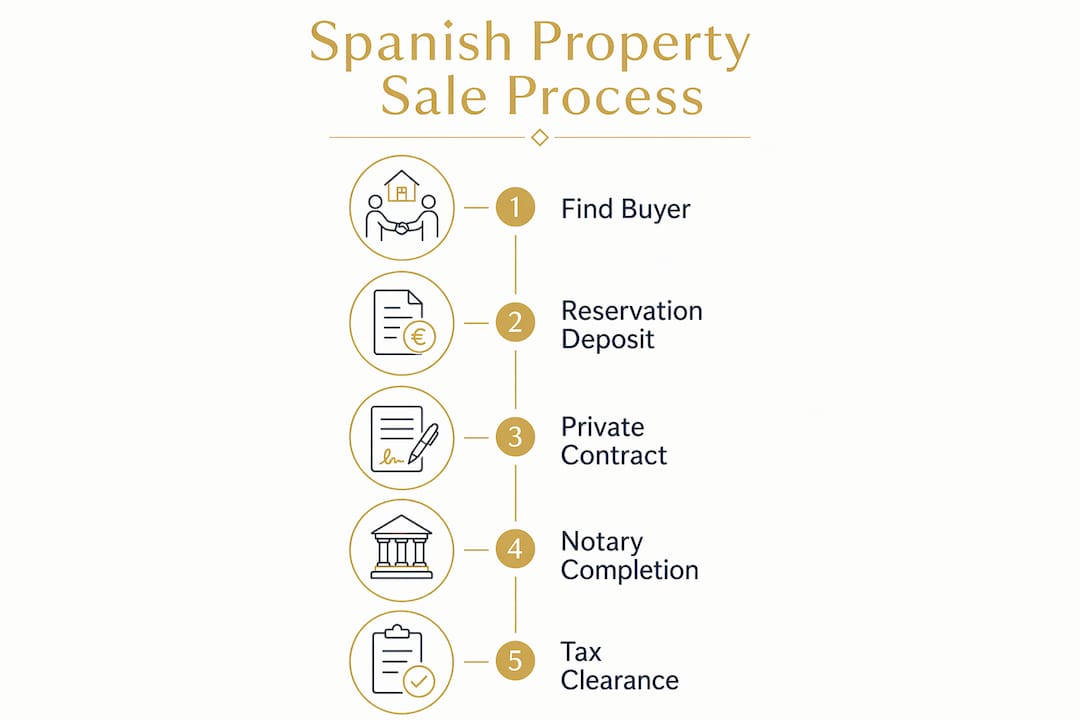
The reservation deposit is typically €3,000–€6,000. It takes the property off the market while both parties prepare the main contract. It is not the same as the formal private contract and carries limited legal weight on its own.
The private purchase contract, known as the contrato de arras penitenciales, is the legally binding agreement. It requires a 10% deposit from the buyer and sets out the agreed price, completion date, and conditions of sale. The penalties for withdrawal are clear and significant.

| Scenario | Consequence |
|---|---|
| Buyer withdraws after signing arras | Buyer forfeits the full 10% deposit |
| Seller withdraws after signing arras | Seller must return double the deposit received |
| Both parties agree to cancel | Terms negotiated; no automatic penalty |
| Completion delayed by buyer | Seller may pursue legal remedy or renegotiate |
These penalties exist to protect both parties. As a seller, you should treat the arras contract as a firm commitment. Withdrawing after signing is costly and can expose you to legal action beyond the financial penalty if the buyer disputes the reason for withdrawal.
Pro Tip: Always have an independent lawyer review the arras contract before signing. The standard template favours neither party, but specific clauses around completion dates and conditions can be negotiated to protect your position.
What happens at completion with the notary?
The notary, known in Spain as the notario, formalises the sale by witnessing the signing of the public deed of sale and verifying that all taxes and debts have been settled. The notary’s role is public formalisation, not legal advice. This distinction matters enormously for international sellers.
Spanish property law is not solicitor-led. The notary does not represent your interests. An independent lawyer is the only professional at the table whose job is to protect you. Without one, you may sign a deed that contains errors, omissions, or unfavourable terms without realising it.
The completion process follows these steps:
- Both parties (or their representatives) attend the notary’s office on the agreed date
- The notary reads the deed aloud and confirms all parties understand the terms
- The buyer pays the agreed balance, typically by banker’s draft
- The 3% tax retention is deducted from the purchase price and paid to the Spanish Tax Agency
- The signed deed is handed to the buyer, who registers the transfer at the land registry
Most non-resident sellers complete via power of attorney, which allows a trusted representative in Spain to sign the deed on their behalf. This avoids the need to travel to Spain for a single appointment. The power of attorney must be notarised, either at a Spanish consulate in your home country or at a local notary with an apostille stamp, and arranged well in advance of the completion date.
Pro Tip: Arrange your power of attorney at least four weeks before the scheduled completion date. Apostille processing times vary by country and delays here can push back the entire transaction.
What tax obligations must non-resident sellers meet?
Tax compliance is the area where international sellers most frequently make costly errors. The Spanish property sale process imposes two distinct tax obligations on non-resident sellers: the 3% retention and capital gains tax.
The 3% retention (Form 211): The buyer withholds 3% of the agreed purchase price at completion and pays it directly to the Spanish Tax Agency as an advance against the seller’s capital gains liability. This is not optional and applies regardless of whether you make a profit on the sale.
Capital gains tax (Form 210): After completion, you must file Form 210 to declare your actual capital gains and either pay any additional tax owed or claim a refund of the excess retention. The filing deadline is four months after the sale date. Missing this deadline forfeits your right to reclaim any overpaid retention. Refunds, when approved, typically take 6–12 months to arrive.
Capital gains tax rates for non-residents:
- 19% for sellers resident in EU or EEA countries
- 24% for sellers resident outside the EU or EEA
Plusvalía Municipal: This is a separate municipal tax on the increase in the cadastral value of the land since you purchased it. From 2026, sellers can choose between two calculation methods: the Objective Method, based on a government formula, or the Real Gain Method, based on actual price appreciation. You choose whichever results in lower tax. You must report the sale to the local town hall even if the calculation produces no liability.
The Spanish buying fees guide covers the tax side from the buyer’s perspective, which is useful context when negotiating who bears which costs at completion.
What are the most common legal mistakes sellers make in spain?
Several avoidable errors consistently delay or derail Spanish property sales. Knowing them in advance puts you in a far stronger position.
Registry and cadastre discrepancies are the most frequent cause of hold-ups. If your property has been extended, a terrace enclosed, or a pool added without updating the land registry, the title deed will not match the physical property. Buyers’ lawyers flag this immediately. Resolving it requires a declaración de obra nueva, which takes time and money.
Unresolved community or municipal debts also block sales. Outstanding service charges, unpaid IBI (property tax), or debts to the local municipality attach to the property, not the owner. A buyer’s lawyer will find them during due diligence and will either demand they are cleared before completion or deduct the amount from the purchase price.
Misunderstanding the notary’s role leads sellers to attend completion without independent legal representation. The notary will not flag a clause that disadvantages you. Only your own lawyer will.
Missing the Form 210 deadline is a financial mistake with no remedy. Failure to file within four months after the sale permanently forfeits the right to reclaim excess 3% retention. On a €300,000 sale, that retention is €9,000. Losing it to a missed deadline is entirely avoidable.
“Legal preparation is the single biggest factor in avoiding transaction collapse, especially updating registry data and clearing community debts before listing.”
Pro Tip: Appoint a specialist property lawyer before you accept any offer. The cost of legal representation is modest compared to the financial exposure of completing without it.
Key takeaways
The selling Spanish property legal process requires thorough preparation, independent legal representation, and strict tax compliance to complete successfully as a non-resident seller.
| Point | Details |
|---|---|
| Prepare documents early | Gather your Nota Simple, title deed, energy certificate, and community clearance before listing. |
| Understand arras contracts | The 10% deposit contract binds both parties; seller withdrawal means paying double the deposit back. |
| Use power of attorney | Non-resident sellers can complete without travelling by appointing a representative in Spain. |
| File Form 210 on time | Missing the four-month deadline forfeits your right to reclaim excess 3% tax retention. |
| Appoint an independent lawyer | The notary formalises the sale but does not advise you; only your own lawyer protects your interests. |
Why i think most international sellers underestimate the legal side
Having worked with international property sellers along the Western Costa del Sol for years, I have seen the same pattern repeat itself. Sellers focus on price, presentation, and finding a buyer. The legal process feels like an administrative formality. It is not.
The 3% retention alone surprises most non-EU sellers. On a €400,000 sale, €12,000 leaves your hands at completion and sits with the Spanish Tax Agency. You get it back only if you file Form 210 correctly and on time. Many sellers do not realise this until the day of signing.
Power of attorney is another area where sellers hesitate unnecessarily. The process is straightforward, the cost is low, and it removes the need to fly to Spain for a single appointment. I would always recommend arranging it early rather than scrambling in the final weeks before completion.
The most important decision you make is appointing an independent lawyer before you accept an offer. Not after. Not at the arras stage. Before. A good property lawyer in Spain will check your registry entry, identify any debts or discrepancies, review the arras contract, and represent you at completion. The fee is typically 1% of the purchase price. The protection it buys is worth far more.
The guide to selling property in Spain covers these steps in detail if you want a fuller picture before you commit to a sale.
— Nina
How Omnirealestate supports international sellers on the costa del sol
Omnirealestate has spent over a decade working with international sellers across Estepona, Duquesa, Manilva, Casares, and Sabinillas. The team understands the specific legal and logistical challenges non-resident sellers face, from tax retention to power of attorney arrangements.

If you are considering selling, Omnirealestate offers professional property valuations to establish an accurate asking price, alongside bespoke marketing packages designed to reach qualified buyers quickly. The team can also refer you to trusted independent legal and tax specialists who handle non-resident seller obligations, including Form 210 filings and arras contract reviews. Contact Omnirealestate directly for a personalised consultation and to find out what your property is worth in the current market.
FAQ
What documents do i need to sell property in spain?
You need your title deed, a current Nota Simple from the land registry, an Energy Performance Certificate, a habitation certificate, a community fees clearance certificate, and your cadastral reference. Non-resident sellers also need a Spanish bank account for tax refund purposes.
How does the 3% tax retention work for non-resident sellers?
The buyer deducts 3% of the purchase price at completion and pays it to the Spanish Tax Agency on your behalf. You then file Form 210 within four months to declare your actual capital gains and reclaim any excess retention paid.
Can i sell spanish property without travelling to spain?
Yes. Most non-resident sellers complete via power of attorney, allowing a representative in Spain to sign the deed on their behalf. The power of attorney must be notarised and apostilled in your home country before completion.
What is the arras contract and why does it matter?
The arras penitenciales is the private purchase contract that commits both parties to the sale. The buyer pays a 10% deposit; if the buyer withdraws, they lose it. If the seller withdraws, they must return double the deposit received.
How long does selling property in spain take?
The full process typically takes 6–12 weeks from offer acceptance to notary signing. Mortgage-dependent buyers add 4–6 weeks to that timeline. Post-completion land registry updates take a further 1–4 weeks.