



Property capital gains tax in Spain is the tax levied on the profit you make when selling a Spanish property, formally known as Impuesto sobre la Renta de No Residentes (for non-residents) or as part of IRPF for residents. The rate you pay depends entirely on whether you are a Spanish tax resident or not, and two separate taxes apply on every sale: the national capital gains tax and the municipal Plusvalía tax. Understanding both before you buy is not just useful. It is the difference between an accurate investment forecast and a costly surprise at completion.
What is property capital gains tax in Spain?
Property capital gains tax in Spain is calculated on the net profit from a sale, not the full sale price. The taxable gain is the difference between what you sell for and what you originally paid, adjusted for allowable costs. Spain’s tax authority, the Agencia Estatal de Administración Tributaria (AEAT), administers this tax and enforces compliance for both residents and non-residents.
Residency status determines which rate applies and which reliefs you can access. Residents pay tax under the savings income section of their annual IRPF return. Non-residents pay under a separate regime with fewer reliefs available. This distinction matters enormously when you are modelling the net return on a Spanish property purchase.

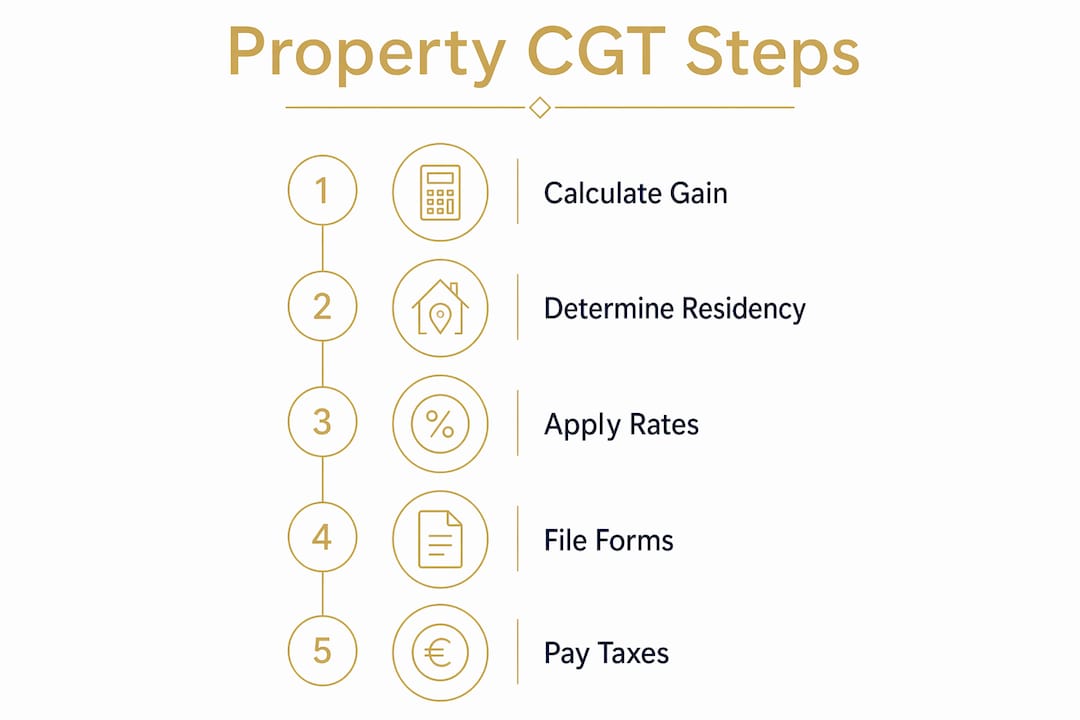
Two tax forms govern the process for non-residents: Form 211, which the buyer uses to remit the mandatory 3% withholding, and Form 210, which the seller files to settle the final liability. Residents have no withholding mechanism. They simply declare the gain in their annual tax return. Knowing this structure before you complete a purchase helps you plan exit costs accurately from day one.
What rates apply for property capital gains tax in Spain?
Non-residents pay a flat 19% on the net gain from a property sale if they are EU or European Economic Area nationals. Non-EU nationals, including UK citizens following Brexit, pay a flat 24% rate. That distinction is significant for British buyers on the Costa del Sol, who now fall into the higher non-EU bracket.
Residents pay on a progressive scale based on the size of the gain. The tiers are as follows:
- €0 to €6,000: 19%
- €6,001 to €50,000: 21%
- €50,001 to €200,000: 23%
- €200,001 to €300,000: 27%
- Above €300,000: 28%
That progressive structure means a resident selling a property with a €250,000 gain pays different rates on each portion of that gain, not a flat 28% on the whole amount. The effective rate ends up lower than the headline figure suggests.
The taxable base is always the net profit: sale price minus the adjusted acquisition cost. Acquisition cost includes the original purchase price plus purchase taxes, notary fees, and registry costs. Selling costs reduce the gain further. The table below summarises the key rate differences.
| Taxpayer type | Rate | Notes |
|---|---|---|
| Spanish tax resident | 19%–28% progressive | Applied under IRPF savings income rules |
| EU/EEA non-resident | Flat 19% | Applied via Form 210 |
| Non-EU non-resident (incl. UK) | Flat 24% | Post-Brexit rate for British sellers |
Pro Tip: If you are a UK national considering a long-term hold in Spain, taking Spanish tax residency before selling could reduce your effective rate significantly, particularly on larger gains.
How does the 3% buyer withholding and Plusvalía Municipal tax affect sellers?
Every non-resident seller faces a mandatory 3% retention at completion. The buyer withholds 3% of the gross sale price and pays it directly to AEAT using Form 211. This is not the final tax. It is an advance payment against the seller’s eventual CGT liability.
The seller then files Form 210 within approximately four months of the sale date. If the 3% withheld exceeds the actual CGT owed, AEAT refunds the difference. If the actual liability is higher, the seller pays the shortfall. Sellers who neglect to file Form 210 can face unexpected tax bills up to 18 months after the sale. That is a risk no investor should take.
Alongside the national CGT, sellers also pay Plusvalía Municipal. This is a separate local tax charged by the municipality on the increase in the cadastral land value during your period of ownership. Plusvalía Municipal generally runs at around 3.6%–3.75% of the assessed land value increase and must be paid within 30 days of the sale.
Since 2021, sellers have the right to choose between two calculation methods for Plusvalía: the formulaic method based on cadastral values, or the real-gain method based on actual land value increase. Sellers can select the lower of the two results. If land values in your area have not risen significantly, the real-gain method can produce a meaningfully lower bill.
Key steps for non-resident sellers:
- Confirm buyer will withhold 3% and file Form 211 at completion
- Obtain a copy of Form 211 as proof of the advance payment
- Engage a tax adviser to calculate your actual CGT liability
- File Form 210 within four months of the sale date
- Pay Plusvalía Municipal to the local town hall within 30 days
Pro Tip: Always model both CGT and Plusvalía Municipal when calculating your net sale proceeds. Sellers who only account for one of the two taxes routinely underestimate their total tax bill.
What costs and documentation can reduce your taxable capital gain?
The taxable gain shrinks when you add legitimate costs to your acquisition price and deduct selling costs from the sale price. Deductible costs include purchase taxes such as ITP or VAT paid on acquisition, notary fees, land registry fees, and legal costs paid at the time of purchase. Every euro added to the acquisition cost reduces the taxable gain by one euro.
On the selling side, you can deduct estate agent fees, notary fees, legal fees, and the cost of an energy performance certificate. These costs are subtracted from the sale price before the gain is calculated. A seller paying 3% in agent fees on a €400,000 sale reduces the taxable gain by €12,000 before any other deductions apply.
Capital improvements are also deductible, but only with formal invoices. Renovations, extensions, and structural works supported by proper documentation reduce the taxable gain directly. Cosmetic repairs and routine maintenance do not qualify. The distinction matters because undocumented improvement costs cannot be claimed. Retaining formal invoices for every purchase, improvement, and sale-related expense is not optional. It is the foundation of an accurate CGT calculation.
The steps for building your deductible cost file are:
- Gather the original purchase deed (escritura) showing the price paid
- Collect receipts for all purchase taxes, notary, and registry fees
- Compile formal invoices for all capital improvements made during ownership
- Obtain invoices for all selling costs including agent fees and legal fees
- Pass the full file to your tax adviser before Form 210 is prepared
Pro Tip: Engage a Spanish tax lawyer or gestor before the sale completes. They will identify deductible costs you may have overlooked and apply them correctly on your Form 210 filing, often saving more than their fee.
How does capital gains tax filing and payment work in Spain?
Residents declare their property capital gains within their annual IRPF return, filed each spring for the previous tax year. The gain sits in the savings income section and is taxed at the progressive rates described above. There is no separate form and no withholding mechanism for residents. The process is straightforward if you have a tax adviser managing your annual return.
Non-residents follow a different process. The Spain-UK double taxation treaty allows British sellers to offset Spanish CGT against their UK CGT liability via Foreign Tax Credit Relief. However, UK tax may still be due if the UK effective rate exceeds the Spanish rate. HMRC requires disclosure of the disposal within 60 days of completion. Missing that deadline triggers UK penalties on top of any Spanish liability.
Filing steps for non-resident sellers:
- Confirm the buyer has filed Form 211 and obtain a copy
- Calculate the actual CGT liability using net gain and applicable rate
- File Form 210 with AEAT within four months of the sale date
- Claim a refund if 3% withheld exceeds actual liability, or pay the shortfall
- Report the disposal to HMRC within 60 days if you are a UK taxpayer
- Pay Plusvalía Municipal to the local municipality within 30 days of sale
Late filing of Form 210 attracts surcharges and interest from AEAT. The longer the delay, the higher the penalty. Buyers and sellers on the Spanish property tax guide from Omnirealestate can find a fuller breakdown of all taxes that apply across the purchase and sale cycle.
Key takeaways
Property capital gains tax in Spain requires sellers to account for both the national CGT rate and the separate Plusvalía Municipal tax to calculate accurate net proceeds from any sale.
| Point | Details |
|---|---|
| Residency determines your rate | Residents pay 19%–28% progressively; non-EU non-residents pay a flat 24%. |
| 3% withholding is not the final tax | Sellers must file Form 210 within four months to settle or reclaim the difference. |
| Plusvalía is a separate obligation | This municipal tax runs at roughly 3.6%–3.75% and must be paid within 30 days of sale. |
| Documentation reduces your liability | Purchase taxes, legal fees, and invoiced improvements all reduce the taxable gain. |
| UK buyers face a double filing obligation | Both AEAT and HMRC require disclosure, with HMRC requiring notification within 60 days. |
Why most sellers get their Spanish CGT calculation wrong
The single most common mistake I see is sellers treating the 3% withholding as the end of the matter. They complete the sale, the buyer retains 3%, and they assume the tax is settled. It is not. The 3% is an advance. The actual liability could be higher or lower, and Form 210 is what reconciles the two. Sellers who skip that filing do not avoid the tax. They simply delay it, with interest and penalties added.
The second mistake is failing to account for Plusvalía Municipal at all. Buyers planning their investment returns often model only the national CGT rate and ignore the municipal layer entirely. On a property held for ten years in a rising market, Plusvalía can represent a meaningful additional cost that changes the net return calculation.
For UK buyers specifically, the post-Brexit shift to the 24% flat rate rather than 19% is a material change that many people are still unaware of. If you are a British national buying in Spain today with the intention of selling in the future, that rate difference should factor into your investment model from the outset. The buying guide for UK buyers from Omnirealestate covers the full tax and legal picture for British purchasers in detail.
My consistent advice is this: engage a Spanish tax lawyer before you sell, not after. The deductions available for purchase costs, improvements, and selling expenses can substantially reduce your taxable gain. But only if you have the documentation to prove them. Start keeping that file from the day you complete your purchase.
— Nina
Buying property in Spain with tax clarity from the start
Understanding your future tax obligations before you buy is what separates a well-structured investment from an expensive lesson. Omnirealestate works with international buyers along the Western Costa del Sol, covering Estepona, Casares, Sabinillas, Duquesa, and Manilva, and provides guidance that goes beyond finding the right property.

With over 7,500 listings and more than ten years of local expertise, the Omnirealestate team helps buyers factor in the full cost picture, including capital gains tax implications, from the very first conversation. Search properties in Spain and speak with an adviser who understands both the market and the tax environment you are buying into. For a broader view of your investment options along the coast, the Costa del Sol investment guide is a practical starting point.
FAQ
What is capital gains tax when selling property in Spain?
Capital gains tax in Spain is the tax on the profit made from selling a property. Residents pay a progressive rate of 19%–28%, while non-EU non-residents, including UK nationals, pay a flat 24%.
How does the 3% withholding work for non-resident sellers?
The buyer withholds 3% of the gross sale price at completion and pays it to AEAT via Form 211. The seller then files Form 210 within four months to settle the actual CGT liability or claim a refund.
What is Plusvalía Municipal and does it apply to me?
Plusvalía Municipal is a separate local tax on the increase in cadastral land value during your ownership period. It applies to all sellers, runs at roughly 3.6%–3.75%, and must be paid to the local municipality within 30 days of the sale.
Can I reduce my capital gains tax bill in Spain?
Yes. Purchase taxes, legal fees, notary costs, and invoiced capital improvements all reduce the taxable gain. Selling costs such as agent fees and legal fees are also deductible, provided you hold formal documentation for each expense.
Do UK buyers pay a different CGT rate in Spain after Brexit?
Yes. UK nationals are now classified as non-EU non-residents and pay a flat 24% rate on net gains, compared to the 19% rate that applies to EU and EEA nationals. UK sellers must also report the disposal to HMRC within 60 days of completion.